Alfred Charles Barker
1819 - 1873
Doctor, photographer
Alfred Charles Barker about 1850
image formerly Hardwicke Knight Collection
 Christchurch from Provincial Council Chamber 26 September 1860


 Cook and Ross' Corner, Colombo Street
14 August 1860
Cook and Ross' Corner, Colombo Street
14 August 1860
 Colombo Street, Christchurch
8 January 1864 at 7am
Colombo Street, Christchurch
8 January 1864 at 7am
 Mr Luck's House, Gloucester Street, Christchurch
14 August 1860
Mr Luck's House, Gloucester Street, Christchurch
14 August 1860
 Christchurch in the 1860s: A photo taken from the Government Buildings
Dr. Barker, photo
Christchurch in the 1860s: A photo taken from the Government Buildings
Dr. Barker, photo
Fifty Years Progress in Canterbury - The Jubilee Number of The Weekly Press Christchurch, N.Z., 1900.
Alfred Charles Barker was born in Hackney, London, England, on 5 January 1819, the fifth child and fourth son of Joseph Gibbs Barker and his wife, Sarah Pritchett Bousfield. Barker was descended from a fifteenth century gentry family, the Barkers of Aston, Claverley, in Staffordshire, and latterly a line of prosperous Birmingham merchants. His father was a wealthy London linen merchant turned evangelist, a puritan whose passion was converting Jews to Christianity. Privately schooled at Hereford, Alfred Barker at the age of 21 entered the medical faculty of King's College, London, where most subjects were taught within the strict orthodoxy of the Church of England.
 Christchurch in the 1860s: A photo taken from the Government Buildings
Dr. Barker, photo
Fifty Years Progress in Canterbury - The Jubilee Number of The Weekly Press Christchurch, N.Z., 1900.
Christchurch in the 1860s: A photo taken from the Government Buildings
Dr. Barker, photo
Fifty Years Progress in Canterbury - The Jubilee Number of The Weekly Press Christchurch, N.Z., 1900.
In 1845 he graduated as a surgeon, and on 1 July he and Emma Bacon were married by his brother, the Reverend William Gibbs Barker, at the parish church of St John, Hampstead. The young doctor practised at Matlock Bath and Rugby, before deciding to emigrate to New Zealand. His object was, his wife wrote, 'to purchase land and be the first doctor among the Colonists who are all well connected families.'
Emma Barker was three months pregnant when they sailed out of Plymouth in September 1850 with their sons, Dick, Sam and baby Arthur, headed for their first southern summer. As surgeon on board the Charlotte Jane , Barker received a free passage and a salary in return for looking after the 150 emigrants and settlers. The Barkers landed at Lyttelton on 16 December 1850, and their first New Zealand-born child, Sarah Elizabeth (Lizzy), was born three months later in their Christchurch tent home, which Alfred humorously dubbed 'Studding Sail Hall'. Four more children were born between 1853 and 1858: Mary, Francis, John and William.
As the only doctor on the Canterbury Plains in the early years of European settlement, Alfred Barker had a large, diverse, and often strenuous practice. Aside from well-remembered eccentricities of dress and manner, Barker was a competent and respected physician. Innovative at best, as in his early use of chloroform for surgery, he is also known to have made a steam bath of his own design. By the time other doctors were establishing themselves in Canterbury, Barker had begun to lose interest in his practice. It had not been as lucrative as he had hoped - some clients simply did not pay - and his own health was marred by a recurring spinal injury caused by a fall from his horse. But it was the tragic death of Emma Barker on 2 October 1858, five weeks after she had borne their eighth child, that hastened his retirement from medicine, although he did retain the post of registrar of births, deaths and marriages.
A complex man, Barker was sometimes generous and loving, at other times stingy and complaining. His investments yielded a sizeable fortune, although he became increasingly preoccupied with them, especially after the death of his wife; he fretted over the youthful activities of his eldest sons, who were considered too dull to take up a profession.
A voracious reader, he was very active among the intelligentsia of the settlement. He contributed papers on Darwinism to the Canterbury Philosophical Institute in 1872 and 1873, published articles in the local press under the name of Syphax, and corresponded with the British scientists Thomas Huxley and Richard Owen. He developed some interesting concepts in aeronautics, involved himself in church and educational activities, and was a competent architect. The library of Christ's College was built from his plans after his death. A spell on the provincial council from 1855 to 1857 left him impatient with political life.
The origin of Barker's interest in photography is uncertain, although he may have learned the wet-plate process from the Christchurch architect Benjamin Mountfort. His earliest authenticated photographs date from 1858, but he probably started a year or two earlier, judging from an undated set of small family portraits which may have been made with a lens from his brother's telescope in a home-made camera.
By December 1858 Barker had achieved the first of a series of successful portraits of Anne Bowen, a close family friend. He built a darkroom at his home on the edge of Cathedral Square, and devoted himself to photographing family and friends, the growing settlement, local events, his land purchases, and zoological specimens of interest. He made hundreds of negatives, gave generously of his prints, and involved his whole family in the process. His son Samuel made an important series of photographs in the Chatham Islands in 1873, and it is evident from the easy familiarity with which she described her father's photographic activities in her memoirs that Elizabeth Barker had been involved with the medium.
While Barker's photographs exhibit the typical hallmarks of frontier photography of his era - a hotchpotch of formats, crudely cut glass negatives, inconsistent exposures and uneven emulsions - such crudeness does not hide his talent. His work in the new medium shows a spark of life and truth that he could not capture in pen or pencil, and his best portraits are superb. The photographs of his family and their activities are tender and revealing. A handful of his Christchurch views go beyond being invaluable historical evidence; such works as his domestic interiors, for instance, are rare documents. His most haunting series, however, is an extraordinary collection of self-portraits made from 1858 until a month before his death in Christchurch on 20 March 1873, from meningitis.
JOHN B. TURNER
'Annalist'. 'Makers of Canterbury, No 34: Dr Alfred Charles Barker'. Press. 27 Sept. 1930
Burdon, C. C. Dr A. C. Barker. Dunedin, 1972
Cresswell, D. 'Barker of Cathedral Square'. New Zealand Free Lance. 1 April 1953
Knight, H. Photography in New Zealand. Dunedin, 1971
Woodward, J. A Canterbury album. Lincoln, 1987
HOW TO CITE THIS BIOGRAPHY:
Turner, John B. 'Barker, Alfred Charles 1819 - 1873'. Dictionary of New Zealand Biography, updated 22 June 2007
URL: http://www.dnzb.govt.nz/
The original version of this biography was published in the Dictionary of New Zealand Biography Volume One (1769-1869), 1990
© Crown Copyright 1990-2009. Published by the Ministry for Culture and Heritage, Wellington, New Zealand. All rights reserved.

 Dr. Barker, photos
Fifty Years Progress in Canterbury - The Jubilee Number of The Weekly Press Christchurch, N.Z., 1900.
Dr. Barker, photos
Fifty Years Progress in Canterbury - The Jubilee Number of The Weekly Press Christchurch, N.Z., 1900.
Alfred Charles Barker
How would the present-day photographer improvise if he was short of material? Would he be as resourceful as Dr Alfred Charles Barker, who arrived in Lyttelton in 1850? He sometimes used a camera built from a tea chest lined with paper blackened with lamp black - and the lens barrel was no trouble, as this was made from a large empty pill box with the lid of the pill box used as a combined lens hood and shutter. When he could not get glass plates for his camera he cut some from panes of glass removed from windows. Gold and silver salts took so long to arrive from England that Dr Barker sometimes filled in during periods of shortage by melting down sovereigns, silverware and cutlery, so as to get these ingredients for his photographic processes. Typical of this Barker do-it-yourself system was the fact that he cut his own printing paper, and he sized his paper with white of egg which he then hung out to dry on bent pins hooked into string. These examples of resourcefulness will surely strike a sympathetic note with present-day photographers over a hundred years later.

 Dr. Barker, photos
Fifty Years Progress in Canterbury - The Jubilee Number of The Weekly Press Christchurch, N.Z., 1900.
Dr. Barker, photos
Fifty Years Progress in Canterbury - The Jubilee Number of The Weekly Press Christchurch, N.Z., 1900.
The Demonstration. Although many resident in the city continued to display their banners throughout yesterday, the removal of decorations and temporary structures erected for the occasion has been actively carried on. Latimer Square has resumed its wonted aspect, and now that public feeling has found a vent, business again claims undivided attention. In connection with Monday's proceedings, it is worthy of mention that Dr Barker succeeded in obtaining an excellent photograph of the vast assemblage collected in Latimer Square. The violence of the wind, and inability to obtain an elevated site from which to take the view, militated very considerably against the efforts of Dr Barker, but notwithstanding these drawbacks the picture is sufficiently clear and distinct in every detail to give a fair idea of the immense crowd present. The platform is shewn clearly, and so are the military. We have not heard of any professional artist having obtained a similar view. Mementos of Monday's rejoicings, especially in the shape of a photograph, will prove interesting, and would certainly have met with a good demand.
Lyttelton Times, Volume XXIX, Issue 2270, 1 April 1868, Page 2
Who was this man with this enthusiasm for photography which shone so brightly at an age of Victorian politeness and gentility? He was Dr Alfred Barker (1819-1873) and Canterbury owes a debt of gratitude to him as he compiled an almost continuous pictorial record of its early years of settlement. Dr Barker came to Canterbury in 1850 as surgeon on the "Charlotte Jane" and from his first days in the settlement of Christchurch, he recorded its development in pen and pencil sketches. Before he left England he experimented with photography and from 1858 onwards he concentrated on making a photographic record of people, places and events. Its value for posterity was made certain by the meticulous care he showed in documenting the facts about his photographs. The names of the place, the actual hour, were all carefully written on the negative. If only other pioneer photographers had done this, how much easier historians' work would be.
These photographs are important. Letters, diaries, histories, newspapers, and all the written history seems cold and remote unless they are supplemented by a contemporary pictorial record, and Canterbury was lucky that such a fanatical enthusiast as Dr Barker was on hand to record (and to record with considerable artistic merit) the passing parade.
What of the man? When he came to Christchurch at the age of 31 his first home was in Christchurch proper, and the garden of his house extended from the Square to the lower edge of Worcester Street. As one of the very few practitioners serving the whole of the Canterbury Plains, he travelled great distances and was constantly on he move. However the tragic death of his wife in 1858, plus his serious injury when thrown from a horse, prompted him to give up his practice at the early age of 39. He decided, in future, to devote all his time to his hobbies, which were many and varied as he was a studious and industrious man. Besides photography, he was interested in geology, botany, zoology and writing. For instance, he maintained a constant correspondence with Oxen, Huxley and Darwin and often lectured locally on the theories of Darwin.
He eventually built a house on the site of the Christchurch Gas Company's office at the corner of Oxford Terrace and Worcester Street, and his splendid garden provided the setting for many of his photographs. Many of his street scenes seem rather empty, but the answer is simple enough. Most of them were taken in the early morning when he was less likely to have interruptions by inquisitive passersby, and also with long time exposures which were a necessary, there was less chance of someone walking through as a blur in the finished photo if he worked in the very early hours. In addition, Dr Barker had a mobile horse-drawn darkroom. It had four wheels, seats, a roof and at the back was a tall thin compartment ready for his photographic expeditions, which made it possible for him to do on-the-spot preparation of wet plates - plates that he produced prolifically and which became more valuable each year. For example, we have line drawings and verbal descriptions of what a well-dressed women wore in 1865 - but words are unnecessary just a soon as you see a photo by Dr Barker of a well-dressed lady in his garden at that date - and the Canterbury Museum has a great collection of these negatives in safe keeping for posterity.
With the excellence of his technical work, his meticulous recording and, above all, his enthusiasm for photography, Dr Barker must surely be regarded as one of the most important of the trail blazers in photography in New Zealand.
A. P. Bates

THE LATE DR. BARKER.We deeply regret have to record the death of Dr Barker, one of the pilgrim Fathers of the Province, and a gentleman who enjoyed the highest possible measure of esteem from all who knew him. The sad event occurred at a quarter to four o'clock yesterday afternoon at his residence, where he had been confined by illness for about a fortnight. The immediate cause of the illness was attributed by Dr Barker to a sun stroke received a short-time ago, whilst superintending the erection of the new library at the College, the plans for which were his own. There can be little doubt, however, that the actual cause is to be traced back to several accidents he met with in riding on horseback some fifteen years ago, and from which he sustained concussion of the spine. He certainly suffered at intervals for some time preceding his death from a species of paralysis, and had a difficulty in moving about. During the latter part of his illness the symptoms assumed a typhoid form, and, with the exception of a brief interval on Wednesday, he was unconscious for several days before death. Drs Parkerson and Prins were his medical attendants, and were most assiduous in their duties. All the members of his family, except one son (Mr S. D. Barker) who is at the Chatham Islands, were present when death supervened, but of this he was not sensible.
Previous to coming to this province Dr Barker was in practice at Rugby. He left England on the 7th August, 1850, in the Charlotte Jane, one of the memorable pioneer ships which sailed together, and the one which arrived first in Lyttelton Harbour. He was accompanied by Mrs Barker and three sons, and he came out not only as an original purchaser of land, but as medical officer of the ship. Besides arriving in the first of the four ships, Dr Barker had the satisfaction of being taken ashore in the first boat, Messrs J. E. FitzGerald, C. C. Bowen, E. Ward (brother of the late Mr Crosbie Ward), and others being his companions. Immediately after clearing from he ship Dr Barker came over to Christchurch and pitched his tent on the site of his late residence in Cathedral square. From the very first, a kindly disposition, liberality, and consideration for others were his distinguishing characteristics. Those who came over from Lyttelton to present their land orders at the old Land office, now the Resident Magistrates' Court, had indeed good cause to remember the honest, hearty welcome, and great hospitality which he extended to all. He was the only medical man on the Plains for many years, and his skill combined with the most thoughtful attention, endeared him to all patients. He took a very active interest in politics, and was ever one of the foremost advocates of progress. He was member for Christchurch in the Provincial Council for several years, and also contributed very largely to the correspondence columns of this journal, his letters displaying considerable acumen and power. He discontinued his medical practice shortly after the loss of his wife, some fourteen years ago, and thenceforth devoted himself very strenuously to literary and scientific pursuits. At the time of his death he was a Fellow of Christ's College, a trustee of the Museum, and one of the most active members of the Philosophical Institute. He zealously aided the promotion of literary and scientific objects in the province, and there was a fresh enthusiasm in all he did which made him a valuable colleague in any work. He was an amateur photographer of considerable skill - his pictures of the inauguration of the Godley statue and of the early settlers, taken in the twenty-first anniversary of the province, being worthy of what they are, national memorials - and he had some pretensions to architectural ability, as shown by his plans, gratuitously prepared, for the College library building which will be a credit to the city when finished. His anxiety in the work was very great, inducing a restlessness which it is very probable hastened his death. In conclusion it can only be said that thorough integrity, his kindly, genial, and honorable feelings made him deeply loved by a large circle of friends, who will mourn his loss.
The funeral will probably take place on Monday next.
Star, 21 March 1873, Page 3 (Friday)
The Late Dr. Barker —The obsequie of the late Dr Barker took place yesterday and time province may be said to have testified its respect for the memory of one of its earliest and most respected settlers in a fitting manner. As a public event it stands prominent above all other funerals that have taken place for many years, and the depth of feeling was quite equal to the display. Long before the hour appointed for the cortege to start, the vicinity of the deceased’s late residence was thronged by people and carriages, the former it may be truly said comprising not only a considerable number of early settlers, but a large majority of the men of influence and position in the province. There was also a considerable number of spectators, who appeared to have been attracted by something more than mere curiosity. The bell of St. Michael’s tolled during the preparations for the funeral, which were completed shortly after two o’clock. The coffin was then borne from the house with his Honor Mr Justice Gresson, Drs Donald, Parkerson, and Prins, Mr B. J. Lee and Lieut. Macfarlane officiating as pall-bearers. The coffin having, been placed in the hearse, the cortège moved away in the direction of the cemetery. Two mutes preceded the hearse, which was drawn by four horses, and flanked on each side by a number of mourners. A large mourning coach followed, containing deceased’s five sons, Mr F. C. Barker, Mr Hawdon, and Mr R. D. Thomas, relatives of the family. Three carriages came next, the Right Rev, the Primate of New Zealand, Dr Donald, Mr E. J. Lee, and Lieut. Macfarlane being in the first; the Very Rev. the Dean of Christchurch, Mr F. Thompson and Mr Cass, in the second; and Doctors Parkerson and Prins, deceased’s medical attendants in the third. After these there were fifty gentlemen on foot, his Honor the Superintendent, Mr J. C. Watts Russell, the hon. E. Gray, Canon Cotterill, members of the Provincial Executive, leading members of every profession in the city, and many prominent commercial gentlemen being amongst the number. Thirty private carriages followed, including those of Sir Thomas Tancred, Bart., Sir J. C. Wilson, K.C.S.L, the Archdeacon of Christchurch, his Worship the Mayor, and others; next came the masters and students at the College numbering in all 130, the rear being brought up by a number of horsemen. The route taken was through Cathedral square, on through Colombo street and Armagh street, across the Madras- street bridge, and by Cambridge terrace to the Church of England cemetery. All places of business en route were closed, and the blinds were also close drawn in almost every house. The procession was received at the gates of the cemetery—where from two to three hundred persons had assembled—by the Dean who officiated throughout the funeral ceremony. The deceased was interred in the family plot of ground, by the side of the late Mrs Barker, who died about sixteen years ago. The funeral being over the vast assemblage, numbering from five to six hundred persons separated. The general arrangements had been entrusted to Mr H. Fuhrmann, undertaker, who discharged his duties exceedingly well.
Star, 25 March 1873, Page 2
Press, Volume XXI, Issue 2396, 9 April 1873, Page 4
Important sale of valuable furniture, engravings, books, photographic
apparatus, pianoforte, wagonette, cow, &c, &c.
Mr H. E. Alport has received instructions to sell by public
auction, At the residence of the late Doctor Barker, Cathedral square,
Christchurch, on Thursday and Friday next, the 17th and 18th April, as follows,
viz
DRAWING-ROOM FURNITURE. Handsome drawing suite (walnut couch and chairs, covered
green rep), Walnut loo table, coffee tables, Brussels carpet, 21ft x 21ft, and
hearth rug, valuable clock, by Savory, Paris, under glass shade, framed
engravings, chimney ornaments, fender and fire-irons, coal hod, green rep and
curtains, poles and rings .
DINING-ROOM AND LIBRARY. Mahogany tables, cane-seat chairs, mahogany book-case, kauri
do., Brussels carpet and hearth-rug, Pianoforte, by Rollo, Parian marble vases,
kerosine lamps, framed engravings, 500 volumes books histories, biographies,
voyages and travels, scientific works, medical works, "Cornhill
Magazine," "Good Words, "Illustrated London News," bound;
Blackwood's Magazine," &c, &c. Bagatelle table, cues and balls
complete.
PANTRY, KITCHEN, AND DAIRY.Electro-plated ware, table cutlery, glass, china,
earthenware, brushware, cooking and other utensils, table linen, churn, milk
pans, butter prints, &c.
BEDROOM. Four-post mahogany bedstead, iron and wood
bedsteads, mahogany clothes-press, mahogany bedsteps, toilet tables,
looking-glasses, wash-stands, chamber ware, Beds, mattrasses, blankets, sheets,
quilts, towels, carpeting, chairs, japanned bath, &c, &c.
PASSAGE, Oil-cloth, lamps, clock, &c.
STABLE, &c.1 well-made waggonette and harness, 1 American wagon,
well-bred dairy cow.
A superior assortment of photographic apparatus and
chemicals, cameras, lenses, porcelain baths, dishes, stoppered bottles, &c,
&c.
Sale each day at 11 precisely. Catalogues of the sale to be
had on and after Monday, the 14th instant, at the office of the Auctioneer,
Hereford street, Christchurch.
Press, Volume XXI, Issue 2398, 11 April 1873, Page 3
Drill Shed Entertainment. Upwards of a thousand persons assembled in the Drill Shed last evening, on the occasion of the second entertainment given in aid of the cricket club and other pastimes of Gloucester street schools... A number of very superior dissolving views were exhibited by Professor Bickerton and Mr Seager. One view, of Christchurch in the year 1852, from a photograph by the late Dr Barker, in particular, excited the interest of the audience.
Star, Issue 2685, 4 November 1876, Page 2
Mr Ronald Barker, grandson of the late Dr. Barker, has produced a couple of very interesting series of photographs from negatives taken by his grandfather. The first of the series will appeal strongly to the large number who are proud to claim Christ's College as their alma mater. The pictures comprise views of the College and headmaster's house from the first domicile on Oxford terrace to 1869.
The second series is a pictorial history in brief of the Anglican Church, in Canterbury, comprising portrait of Bishops Selwyn and Harper, Dean Jacobs, Archdeacons Harris end Wilson, and the Rev. Croasdaile Bowen.
There is also an historical group of bishops taken on the occasion of the first meeting of the first General Synod in Christchurch, with portraits of Bishops Harper and Selwyn, Abraham (Wellington), Williams (Waiapu), and Patterson (Melanesia).
Some pictures of churches include St. Michael's, 1861; the interior of the old St. Michael's; laying the foundation stone of the new St. Michael's; St. Michael's, 1872, and the interior of the new St. Michael's Harewood road Church, 1863; Avonside Church, 1870; Riccarton Church, 1863; St. Stephen's, Kaiapoi, 1863; Governor's Bay Church, 1865; Geraldine Church, 1866; and Mount Peel Church, 1872.
Press, Volume LXVI, Issue 13652, 9 February 1910, Page 6
A Photographic History.
To The Editor of "The Press."
Sir, — Following on your leading article under above title in "The Press," February 14th, you will, be interested, to know the recommendation contained in the leader is further reaching than you may have anticipated, and I shall not be required to beg pardon for referring to the subject again.
The Rev. Canon Stack, from far-away Great Britain, who had occasion to thank me for finding a much cherished but long-lost photograph taken in the early sixties, proves in the following extract, which I take the liberty of quoting, what a deep interest would be felt in the photographic history of Canterbury, which it appears was contemplated by Dr. Barker about 1865:
"You have given me something that I shall prize highly, the photo of my old church, St. Stephen's, Kaiapoi, taken by Dr. Barker. I have fretted a good deal about the loss of an original copy which Mr S. Barker gave me. It was with several others I treasured when we moved from our villa at Bordighera, Italy, to Worthing, England. The history of the original plate is this: Dr. Barker found in photography a pleasant source of recreation, and conceived the idea of forming a pictorial history of the changing period through which Canterbury was passing in the sixties when the old shanties, raupo huts and tents were being replaced by substantial buildings. So he procured a sort of Gipsy van and fitted it as a photographic studio, and then he made a tour of the province commencing with Christchurch, and its immediate neighbourhood. In the course of his tour he appeared one morning at St. Stephen's, I was away on one of my missionary visits to the Peninsula, but Mrs Stack induced a number of the Maoris to gather round the church door, and the school children, under Miss Taylor, the teacher, and our children and the nurse, Miss Comyns, formed part of the group — Mrs Stack is the lady with crinoline in the foreground. The Paddy O'Rafferty in a belltopper is Te Aika, the white beard is Albert Koti, Wi Naehira and C. Tehoika were in the crowd. On getting home I was not quite pleased to find that the natives presented a rather shabby group, for I would rather they had been in Maori mats, but Dr. Barker was in such a hurry he could not wait till more natives had assembled, and had dressed for the occasion."
I wish to stress the fact that the most laudable and hard work of beginning the pictorial history should be kept in view, and the now scattered negatives, as well as the prints from negatives damaged and broken, should be collected, and good enlargements made, for the purposes of the photographic history. It will be the work of many to unite in restoring the pictures to some central depot from which copies may be printed to supply the standard record albums to be preserved in the Canterbury Museum. - Yours, etc., J. L. W. March 16th.
Press, Volume LIV, Issue 16165, 20 March 1918, Page 9
Dr. Barker's Photograph Records.
To The Editor of "The Press"
Sir, — The history of Canterbury in its photographs is contained in an invaluable collection of negatives by the late Dr. Barker, which is gradually being spread about and for want of a place for safe-keeping is in danger of being lost. The last place of depositing is proposed to be in the City Council Chambers building — about the most unlikely place for safekeeping. Glass negatives, for one thing, become very fragile and difficult to manage except in expert hands. I have already some years ago suggested that all the plates should be well copied by a skilled person, and the pictures placed in strongly made albums in order that they may be inspected as required. The plates could then be put in labelled and numbered envelopes, packed up, sealed and deposited in the Museum. If thought necessary there could be a fee collected at the "Museum for inspection of the albums, and a charge for copies to be paid by persons requiring the same.
Many pictures have been copied for lantern slides, though where they are few people know, and some of them are possibly broken. The Pilgrims are the ones who should propose a syndicate or co-operative society to secure publication of Barker's pictures and portraits of Pilgrims, etc. Some still remember the efforts of the Christchurch Press Company in printing in "Illustrated Canterbury" (1900) something like what I suggest, and they did it very well up to its point of making it pay, but the Pilgrims could go one better, thus securing a copyright to the Barker collection.
Till now the Deans, Andersons, Bowens, Bishops, etc., have kept up the Pilgrims' gatherings. The time has come to make it a co-operative affair on the lines of the Old Scholars' Associations, in which every one is a partner in the expense and the first sign of their interest, would be to make the best of the pictures before there is a fire or some accident which puts the whole out of etc., J.L.W. May 5th, 1925.
Press, Volume LXI, Issue 18374, 6 May 1925, Page 11
J.L.W. - Joseph Lowthian Wilson was the Press correspondent in North Canterbury, having his office in Cookson Street, Kaiapoi, refer Press, Volume LXII, Issue 18817, 8 October 1926, Page 12
Tamihana te Rauparaha (left), Christchurch, January 1869.
image formerly Hardwicke Knight Collection.
Posters on the south-east corner of Cathedral Square, 10 January 1866
image formerly Hardwicke Knight Collection.
Samuel Delabere Barker, December 1864.
image formerly Hardwicke Knight Collection.
"A. C. Barker, Christchurch, N.Z., Nov. 28 1864."
image formerly Hardwicke Knight Collection.
A. C. Barker
image formerly Hardwicke Knight Collection.
Barker, wearing topee [pith helmet], and his mobile darkroom, known as "The Travelling Medium" - a familiar sight in Christchurch in the 1860s. From the Weekly Press Jubilee Number, 5 December 1900. Photography in New Zealand by Hardwicke Knight, page 30.
Photograph dated 1 December 1869
image formerly Hardwicke Knight Collection.
In this argument, making the point is James Edward Fitzgerald, former Superintendent of Canterbury from 1853 to 1857, first editor of the Lyttelton Times and later, from 1860, founder and editor of The Press, with, listening, William Rolleston who was Superintendent of Canterbury from 1868 to 1876 and who had, in 1868, the year previous to this photograph, been elected a member of the House of Representatives. Fitzgerald was a fellow passenger of Barker on the Charlotte Jane. Photography in New Zealand by Hardwicke Knight, page 26
A. C. Barker and family
image formerly Hardwicke Knight Collection.
The family and Descendants
of
Alfred Charles Barker
Alfred Charles Barker, born 5 January 1819 Hackney, London, England the
fifth child and fourth son of Joseph Gibbs Barker and Sarah
Pritchett Bousfield, baptised 9 January 1819, St Johns, Hackney, died 20 March 1873 at his residence, Worcester Street, Christchurch, from meningitis, buried 24 March 1873, Barbadoes Street Cemetery, Christchurch plot 22 aged 54. Married 1 July 1845 at the Parish Church of
St John, Hampstead, London, Emma Bacon, born 18 February 1820 the daughter of Samuel Owtram Bacon and Mary Pritchett, baptised 16 March 1820 Whites Row Independent, Spitalfields, buried 6 October 1858, Barbadoes Street Cemetery, Christchurch plot 22, (she was Barker's second cousin, her sister Sophia Bacon married his brother Rev. William Gibbs Barker on 18 November 1835 St Peter, Hereford).
 |
| Dr Barker's headstone in the Barbadoes Street Cemetery, Christchurch - 10 January 2014. |
|
issue:
1. Richard Alfred Barker born 11 July 1846 Rugby, England, bapt. 23 August 1846 Kenilworth, Warwick, England, died 4 February 1891 at his residence Ohapi, Orari, buried Temuka Cemetery, unmarried.
The South Canterbury Hospital and Charitable Aid Board are to come in for a bequest. Some years ago Mr Richard Barker, brother of the late Mr S. D. Barker, bequeathed to the Board a sum of £2000, for the erection of a septicaemia ward at the Hospital. The money was not to be handed over to the Board, so long as Mr. S. D. Barker lived, as he was to have a life interest in it. At his death the whole sum was to be passed to the Board, and as that occurred on Tuesday last, it is probable that the Board will soon reap the benefit of the legacy.
Press, Volume LVIII, Issue 11076, 21 September 1901, Page 7
Richard Alfred Barker's headstone in Temuka Cemetery - December 2014
 |
| Samuel Delabere Barker by Standish and Preece |
2. Samuel Delabere Barker born 6 February 1848 Rugby, England, reg. Mar 1848 Rugby vol. 16 page 501, bapt. 5 March 1848 Saint Matthews, Rugby, Warwick,
England, died 17 September 1901 Cranmer Square, Christchurch aged 53, buried 19 September 1901, Linwood Cemetery block 5, plot 1, married 1 October 1878 St Peter's Church, Riccarton, Christchurch, Frances Harriet Lean [or Frances Harriette Lean], second daughter of Clara Eliza Haines and Alexander Lean of Christchurch, architect, died 5 April 1939 Marton.
issue:
2a. Theodore Delabere Barker born 19 August 1879 Kynnersley, Temuka, reg. 1879/17754, died circa 1953, reg. 1953/21409, married circa 1912, reg. 1912/2588 Ella Wilhelmina Russell daughter of Gertrude Maria Murray and William Fairweather Russell [W. F. Russell - Captain 65th Regiment, Maori Wars, later Manager of Bank of New Zealand in Wanganui - died 7 March 1924]
2b. Mary Frances Barker (school-mistress) born 3 September 1880 Coker's Hotel, Christchurch, reg. 1880/14505, bapt 6 October 1880, Christchurch, died 7 June 1920 Wellington Diocesan Collegiate School, Marton, reg. 1920/9684.
2c. Herbert Lean Barker [or Hubert Lean Barker/Hubert Leon Barker] born 25 April 1882 Kynnersley, Temuka, reg. 1882/19293, died circa 1964, reg. 1964/43660, married 19 April 1911 at St Stephen's Church Ashburton, reg.
1911/6190 Hilda Frances Whitehouse second daughter of Elizabeth and Rev. Edwin. Whitehouse of
Ashburton.
2d. Viola Constance Barker born 21 July 1883 Kynnersley, Temuka, reg. 1883/18985, died circa 1958, reg. 1958/32265.
2e. Alfred Charles Barker born 25 April 1885 Kynnersley, Temuka, reg. 1885/16653, died circa 1950, reg. 1950/31128, married circa 1915, reg. 1915/3577 Ida Walker.
2f. Ronald Delabere Barker born 29 May 1889, reg. 1889/9817, bapt 18 August 1889 Christchurch.
2g. Ethel Leila Barker born 21 October 1891 Church Street, Ferry Road, Christchurch, reg. 1891/15285, bapt 3 January 1892 Christchurch, died circa 1949, reg . 1949/17038, married 14 April 1915 St Stephen's Church, Marton, Norman David Anderson, second son of Edward Anderson, Wellington.
3. Arthur Llewellyn Barker born 28 August 1849 Rugby, England, reg. Dec 1849 Rugby vol. 16 page 471, bapt. 3 October 1849 Kenilworth, Warwick, England, died 14 September 1938 Christchurch or Wainui, Winchester, buried 16 September 1938, Barbadoes Street Cemetery, Christchurch plot 22 aged 89, married 15 January 1885 Church of St Mary, Halswell, Helen Mary Gray, born August 1864, Coldstream, New Zealand, died October 1955, eldest daughter of Margaret MacPherson and Hon. Ernest Grey MLC 1867-1883, of Hoon Hay. Helen Mary Gray was a cousin of Marion Cox the wife of Francis Henry Barker. [Margaret MacPherson was the sister of Mary MacPherson (Mrs Alfred Cox). They were daughters of Catherine MacPherson and Lieutenant-Colonel Ewen MacPherson of the 99th Regiment.]
issue:
3a. Wyndham Ewen Barker born 18 May 1886 Hoon Hay, reg. 1886/5067, bapt 28 June 1886 St Michael's Church, Christchurch, died circa 1958, reg. 1958/33320, married Selly Bendieu
3b. Herbert MacPherson Barker [or Herbert McPherson Barker] born 18 August 1887, reg. 1887/7216, died circa 1973 reg. 1973/28136, ashes buried 9 May 1973 Barbadoes Street Cemetery, Christchurch [1973 - retired engineer, 17 Shrewsbury Street, Christchurch]. 3c. Major-General Richard Ernest Barker CBE, Royal Signals, born 3 October 1888, reg. 1888/9661, died 6 April 1962, reg. 1962/24692, headstone at Barbadoes Street, Cemetery, married circa 1920, reg. 1920/5943 Dorothy Enid Millton, 1898-1977, 2nd daughter of Frederick and Lilian Millton.
3d. Helen Mary Gray Barker born 1 February 1890 Hoon Hay, Christchurch, reg. 1890/3406, bapt 2 March 1890, New Brighton, Christchurch. 3e. George Norman Barker born 17 March 1894 New Brighton, Christchurch, reg. 1894/5714.
4. Sarah Elizabeth Barker born 15 March 1851 Canterbury, New Zealand, reg. 1851/2905, bapt 6 April 1851, St Michael's Church, Christchurch, died 11 September 1921 Timaru, buried Mt Peel, married 10 October 1872 St Michael's Church, Christchurch, Arthur Joseph Hawdon, eldest son of the Hon. Joseph Hawdon, born 5 January 1844, died 29 March 1920 Geraldine, buried Mt Peel.
issue:
4a. Emma Fay Hawdon born 8 June 1873, reg. 1873/33391, bapt 10 August 1873 St Michael's Church, Christchurch, died 1935 aged 61, buried Mt Peel.
4b. Kynard Hawdon born 27 March 1877, reg. 1877/4954, bapt 29 April 1877 St Michael's Church, Christchurch, Captain, 21st Cavalry, died 2 July 1910 of cholera at Srinagar, Kashmir after brilliant service in India.
5. Francis Henry Barker (sheepfarmer) born 20 March 1853 Christchurch, reg. 1853/3612, bapt 17 April 1853 Christchurch, died 30 June 1932 Timaru, buried Timaru Cemetery, married 30 September 1879, Riverslea, South Canterbury, Marion Cox twin daughter of Mary MacPherson and Alfred Cox [1] died 23 November 1914 aged 55, buried Timaru Cemetery. Marion Cox was a cousin of Helen Mary Gray, the wife of Arthur Llewellyn Barker.
issue:
5a. Francis Llewellyn Barker born 18 September 1880 Winchester, reg. 1880/15363, died 25 July 1946, reg. 1946/26998, buried Timaru Cemetery, married 14 January 1904 St Mary's Church, Timaru, reg. 1904/436 Rita Maude Wright [or Rita Maud Wright] second daughter of Amy Jane Perry (sister of Arthur Perry of Beverley) and Augustus William Wright of Craighead, Timaru, born 4 August 1881, reg. 1881/8878, died 23 November 1972.
The headstone of Francis Henry Barker and Marion Barker in Timaru Cemetery.
Photograph - Timaru District Council Cemetery Records, March 2007.
6. Mary Emma Barker born 5 October 1854 Christchurch, reg. 1854/1227, died 21 August 1880 Kynnersley, Temuka, aged 25 years, buried Temuka Cemetery, unmarried.
Mary Emma Barker's grave in Temuka Cemetery with her brother Richard Alfred Barker's headstone behind - December 2014.
 |
| John Matthias Barker in the 1860's by A.C. Barker |
7. John Matthias Barker born 22 September 1856 Christchurch, reg. 1856/5646, bapt 19 October 1856, Christchurch, died 2 July 1933 Waihi, buried Woodbury Cemetery, married 5 October 1882 St Augustine's Church, Waimate, Emily Studholme daughter of Effegenia Maria Louisa Channon and Michael Studholme born circa 1863, died 22 July 1938 Woodbury, buried Woodbury Cemetery. [Emily Studholme's aunt Emily Channon was married in 1856 James William Moorhouse]
issue:
7a. Michael
Studholme Barker born 28 February 1884 Waimate, reg. 1884/12859, died circa 1966, reg. 1966/30751, buried Woodbury Cemetery, married 18 March 1926 South Canterbury, reg. 1926/3346 Constance Mary McArthur, (the artist Constance Barker) eldest daughter of Captain Archibald Wilson McArthur and his wife Ethel Henrietta Musgrave, Forest Road, Geraldine, born 22 July 1897, died 4 January 1975, reg. 1975/28537
7b. Esther Studholme Barker (the artist Esther Hope) born 8 August 1885 Waihi, Woodbury, died circa 1975, reg. 1975/43455, married 26 May 1920 at St Thomas's Church, Woodbury, reg. 1920/6332 Henry Norman Hope, son of Arthur Hope of Tumanako, Timaru.
7c. Paul
Studholme Barker born 4 June 1887 Waihi, Geraldine, reg. 1887/7537
7d. John
Studholme Barker born 12 April 1889 Waihi, reg. 1889/4442, died circa 1962, reg. 1962/24329, married 3 February 1921 St Peter's Church, Riccarton, Mary Eleanor Teschemaker, daughter of Thomas John Cornelius Teschemaker and Rosamond Mary Rolleston (daughter of Hon. William Rolleston and Elizabeth Mary Brittan) born 1 November 1897 at St Clair, Dunedin, died 1971, buried Woodbury Cemetery.
7e. Roland
Studholme Barker born circa 1890, reg. 1890/16076, died circa 1946, reg. 1946/17358, married circa 1932, reg. 1932/7330 Rosalind Mostyn Innes-Jones.
7f. Harold
Studholme Barker born circa 1893, reg. 1893/18532, died circa 1955, reg. 1955/25841, buried Woodbury Cemetery, married circa 1924, reg. 1924/1116 Shirley L'Estrange Nolan daughter Lady Nolan and late Sir
Robert
Nolan.
7g. Doris
Studholme Barker born circa 1895, reg. 1895/13593, married 1927, reg. 1927/2427 Harold Edward Lionel Porter.
7h. Clive Studholme Barker born 4 December 1899, reg. 1900/5361, died circa 1994, reg. 1994/31191, married 7 August 1944, Wellington, Maureen Frengley only daughter of Dr. J. P. Frengley of Christchurch, married 2ndly? Johanna Mary ...
8. William Edward Barker born 26 August 1858 Christchurch, reg. 1858/7612, bapt 21 September 1858 St Michael's Church, Christchurch, died 12 March 1935 Peel Forest, buried Mt Peel, married 1stly 26 Aug 1880, Trinity Church, Darlington, Yorkshire, England, reg. Sep 1880 Darlington, England vol. 10a page 11, Louisa Gertrude Ellen Pritchett daughter of Ellen Mary D'Ewes and James Pigott Pritchett junior (1830-1911), architect, Darlington, England, born circa 1856, Durham, England, died 19 January 1884 at Waikonini, Peel Forest aged 28 years, buried Mt Peel. He married 2ndly 4 July 1887 St John's Church, Christchurch Lucy Mary Pritchett, third daughter of Ellen Mary D'Ewes and James Pigott Pritchett junior (1830-1911) architect, Darlington, England, born circa 1863 Darlington, Durham, died 6 October 1947 Timaru, buried Mt Peel.
[a brother of Louisa and Lucy Pritchett was Rev. Percy Hugh Pritchett the Curate at Rangiora in 1889 and at Hokitika 1892 and Vicar of Mount Somers, Canterbury in 1908.]
issue:
1st marriage to Louisa Gertrude Ellen Pritchett:
8a. Violet Gertrude Barker (nurse of Redcliffs, Christchurch) born circa 1881, reg. 1881/13268, died circa 1946, reg. 1946/29372.
8b. William Percy D'Ewes Barker (1935 - farmer, Geraldine) born 13 November 1882 Waikonini, Peel Forest, reg. 1883/4286, died circa 1965, reg. 1965/34658, married 3 August 1910, St Mary's Church, Timaru, reg. 1910/4823, Ruth Verity Sealy or Ruby Verity Barker daughter of Sarah Frances Sanderson and Edward Percy Sealy
8c. Owen Herbert Barker (1935 - engineer, Peel Forest) born 9 January 1884 Waikonini, Peel Forest, reg. 1884/12630, died circa 1948, reg. 1948/27741.
2nd marriage to Lucy Mary Pritchett:
8d. Grace Minone Barker born 12 May 1888, Waikonini, Peel Forest, reg. 1888/15119, died circa 1972, reg. 1972/36856, married circa 1909, reg. 1909/6221 Charles Ernest Howden (1935 - Medical Practitioner, Waiuku near Auckland).
8e. Charles Hereward Barker born circa 1889, reg. 1889/6445 died 19 September, 1895, buried Mt Peel.
8f. Olive Mary Barker born circa 1890, reg. 1890/16078, died 1980, buried Mt Peel, last surviving granddaughter of Dr A C Barker.8g. Ernest Christopher Barker (1935 - surveyor, Christchurch) born 20 February 1892 Waikonini, Peel Forest, reg. 1892/6782, died 15 July 1946, reg. 1946/34025, buried Waimairi Cemetery, Christchurch, block PR8 plot 36, married Freda Courtney Evans [or Freda Courteney Evans] .
8h. Ruby Gwendoline Barker born 4 July 1893 Waikonini Orchard, Peel Forest, reg. 1893/12437, died 1975, reg. 1975/46490, buried Mt Peel.
8i. Evelyn Lucy D'Ewes Barker born circa 1895, reg. 1895/12701, died 2 July 1901, reg. 1901/5120 aged five and a half years, buried Mt Peel.
8j. Rhoda Elizabeth Barker born circa 1896, reg. 1896/10168, died 21 June 1964, reg. 1964/30950, buried Mt Peel.
8k. James Eric Barker (1935 - farmer, Kaikoura) born 3 September 1899 Waikonini Orchard, Peel Forest, reg. 1899/11097, died circa 1972, reg 1972/44552, married circa 1929, reg. 1929/4719 Gladys Evans Howard.8l. Alan Cedric D'Ewes Barker (1935 - Toronto, Canada) (chemist) born circa 1903, reg. 1903/20368, died 23 November, 1996, Victoria, British Colombia, Canada, buried Mt Peel, last surviving grandchild of Dr A C Barker, married 9 July 1932, St Paul's Church, Vancouver, B.C., Canada, Dorothy Gertrude Owens, born Vancouver, B.C., daughter of George Alfred Owens and Florence Wood
Waikonini, Peel Forest
The Cyclopedia of New Zealand - Canterbury page 887
Mr W. E. Barker's residence, Waikonini, Peel Forest
 |
| Barker family graves at the Barbadoes Street Cemetery, Christchurch - 10 January 2014. |
[1] Kate Cox the other twin daughter of Alfred Cox was married at the same time to F. A. Whitaker, M.H.R., eldest son of Sir Frederick Whitaker of Auckland.
Mt Peel burials - http://genealogyjourno.wordpress.com/rural-cemeteries-of-canterbury-new-zealand/mount-peel-cemetery-church-of-the-holy-innocents/
family tree - http://www.tolliss.com/gedview/individual.php?pid=I4723&ged=Tolliss.ged
Famous Traveller Dead. Captain K. Hawdon. London, July 7 [1910].
The death is announced of Captain Kynard Hawdon, grandson of Mr. Joseph Hawdon, and the hero of the journey through Asia to Quetta in 1904. Captain Hawdon died of cholera at Srinagar, Kashmir.
Captain (then Lieutenant) Kynard Hawdon, a young Indian cavalry officer, belonging to the 21st Prince Albert Victor's Own Cavalry (Daly's Horse), the hero of the Quetta exploit, went overland from London, via the Trans casplan railway, Ashkabad, Meshed, Seistan, and Nushki to Quetta, towards the end of 1904. He had been in charge of a little fort at Jani Khel, on the north-west frontier, and was always reading about Russia's advance towards India. So, leaving London on September 12, he decided to make a dash for India along one of the Russian roads, preferably the shortest. He took a small kit, a revolver, and a sovereign belt as impedimenta. He went to Vienna, thence to Baku, to Krasnovodsk, where he eluded a Russian official who wanted to see a passport that the young officer did not have. Then, entering the great plain of Central Asia by a train with a dining car, his path was by Ashkabad to Meshed. Three miles from Shamkar, on the Russian frontier, two Belgian officials made trouble. At Meshed he found that three months was the time allowed for the journey to Quetta, though it had been done in 50 days-a record march. He only had a month's leave left so he rushed off for Turbat with two Sowars (mounted guides). Pleasing intelligence came that there was no real road, the water was mostly salt, that cholera was raging, that horses were unprocurable, and that the previous travellers had been fired at. The Seylds, reputed descendants of the Prophet, near Turbat, knew about the Russo-Japanese war, and were pro-Japanese to a man, and looked upon Russia as Persia's enemy. The Shah of Persia was using Belgian officials to screw the last kran of taxes from the peasantry. At Gunabah the traveller found fair-haired, blue-eyed Asiatics. Further on a guide played highwayman, and demanded money. He decamped on finding the English- man armed. At Birjaud, after various adventures, the British agent, Dr. Ali, was a welcome friend. This was 335 miles from Meshed after six days' travelling. On October 8 the British Consulate at Seistan was reached. By camel and donkey the traveller pushed on until he reached Quetta. The entire journey from London took 30 days 16 hours.
The Sydney Morning Herald, 8 July 1910, page 7
Timaru Herald, Volume XIIIC, Issue 14245, 11 July 1910, Page 6


 Lyttelton Times, Volume VII, Issue 467, 25 April 1857, Page 7
  Lyttelton Times, Volume VII, Issue 471, 9 May 1857, Page 9
  Lyttelton Times, Volume VII, Issue 471, 9 May 1857, Page 8
 Mountfort's store was located on the west side of Colombo Street between Armagh Street and Gloucester Street.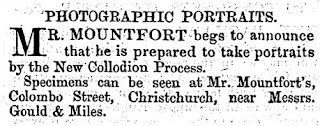
 Mountfort's store was located on the west side of Colombo Street between Armagh Street and Gloucester Street.

 Lyttelton Times, Volume VII, Issue 467, 25 April 1857, Page 7
  Lyttelton Times, Volume VII, Issue 471, 9 May 1857, Page 9
  Lyttelton Times, Volume VII, Issue 471, 9 May 1857, Page 8
 Lyttelton Times, Volume VIII, Issue 506, 9 September 1857, Page 5
  Lyttelton Times, Volume VIII, Issue 518, 21 October 1857, Page 5


.jpg)


