Frisco Studio


Frisco Studio
also known as Frisco Photo Co.
61 Willis Street, Wellington

Evening Post, Volume LXX, Issue 109, 4 November 1905


Evening Post, Volume LXX, Issue 109, 4 November 1905


New Zealand Times, Volume XXVII, Issue 5747, 16 November 1905


New Zealand Times, Volume XXVII, Issue 5771, 14 December 1905
 This notice continued in the New Zealand Times until 13 February 1906


 New Zealand Times, Volume XXVIII, Issue 5785, 1 January 1906
This notice continued in the New Zealand Times until 30 January 1906


New Zealand Times, Volume XXVIII, Issue 5909, 26 May 1906
This notice first appeared about 14 February 1906

Unknown


Unknown Photographer

 A carte de visite by an unknown photographer of an un-named family


MURRAY, Brian


 Brian Murray
Dunedin

born 22 October 1923
died 30 March 1983, reg. 1983/45920  


1946 St. Kilda General Roll, Dunedin
9409 - Murray, Brian, 55 Queens Drive, St. Kilda, photographer

1949 St. Kilda General Roll, Dunedin
9409 - Murray, Brian, 55 Queens Drive, St. Kilda, photographer

1954
St. Kilda General Roll, Dunedin
9230 - Murray, Brian, 218 Forbury Road, St. Kilda, photographer
9264 - Murray, Wynnefred Zona, 218 Forbury Road, St. Kilda, married

1957
St. Kilda General Roll, Dunedin
10582 - Murray, Brian, 24 Cliffs Road, caterer
10618 - Murray, Wynnefred Zona, 24 Cliffs Road, caterer

1963
St. Kilda General Roll, Dunedin
27 - Murray, Brian, 24 Cliffs Road, caterer
02 - Murray, Wynnefred Zona, 24 Cliffs Road, caterer


BARTLEY, Frederick Adolphus


 Frederick Adolphus Bartley
Auckland

born 16 February 1862, Devonport, Auckland, second son of Elizabeth Hannken and Edward Bartley (Architect), killed 26 June 1899 in the General Grant gold mine, Thornborough, North Queensland, Australia aged 37 years.


New Zealand Herald, Volume XX, Issue 6847, 27 October 1883


Auckland Star, Volume XXI, Issue 304, 27 December 1890


On June 27 Mr F. Mason (of the N.Z. River Plate and Land Mortgage Co.) received a cablegram from the manager of the General Grant Gold mine, Thornborough, Queensland, stating that Mr Frederick A. Bartley, (brother-in-law of Mr Mason) had been killed in the mine. No details Were given. The sad news came as a great shock to Mr Bartley's relatives in Auckland. He was a young man of about 37 years of age, and was the second son of Mr Edward Bartley, architect, of Devonport. The deceased was formerly in his father's office in Auckland, and about seven years ago he went to Queensland, where according to his last letters he was engaged in prospecting. His friends, however, did not know until to-day's cable arrived that he was in the General Grant mine. The late Mr Bartley was married in Queensland, and leaves a widow and one child. Much regret will be felt by the friends of the family and by those who knew Mr Fred. Bartley at the news of his sudden end.
Auckland Star, Volume XXX, Issue 158, 6 July 1899


 The Syagogue, Auckland
photograph by Frederick Adolphus Bartley
 Designed by Bartley's father the Auckland architect Edward Bartley, the synagogue was built in 1885 on the corner of Princes Street and Bowen Avenue. Bartley also designed the Auckland Savings Bank Building on Queen Street, St John's Church on Ponsonby Rodd, and the Kings Theatre, now Mercury Theatre, on Mercury Lane.


MONKTON, Charles Henry


Charles Henry Monkton

born circa 1840, arrived Auckland, New Zealand 15 January 1860 from London on the "Jura" as a steerage passenger [1], died 13 April 1890 Minyip, Victoria, reg. 8752/1890 then known as Henry Airey, married 1stly 28 January 1861, reg. 1861/2176 Sarah Jeannett Reed, died 3 June 1872 at the residence of her father, Davy Street, Grahamstown [Thames], married 2ndly 23 November 1881, reg. 1881/2307 Emma Mary Howell

[1] Daily Southern Cross, Volume XVII, Issue 1288, 17 January 1860


Shortland Crescent
Auckland
December 1860 - January 1863 
 
New Zealander
, Volume XVI, Issue 1531, 19 December 1860
 
 
Resident Magistrate's Court.
Saturday, March 16, 1861
Robert Letkey was charged with having stolen articles of the value of 5s. from the premises of Charles Monkton.

Charles Monkton said he was a photographic artist, residing in Shorthand street. The prisoner had been employed by him, but left about a week after Christmas. A month or six weeks ago he missed a bath, value 2s. 6d. and a colour box, value 2s. 6d., both connected with his business. On Thursday last he accompanied a police officer to the prisoner's house in Shortland street. The policeman searched a box belonging to the prisoner, and found the articles mentioned in the information, which he identified. Cross-examined by the prisoner. He was not quite certain whether it was before or after Christmas that the prisoner left him. he believed the box in which the articles were found was the prisoners. It was not locked, and there was no key to it. He never lent or gave the prisoner anything connected with the business.

Prisoner never lent him anything. Prisoner once gave him a brush. When the prisoner left him, the prosecutor said, "There is a good chance for you, and anything I can do for you I will." The prisoner never had the use of the articles while with him, for he was using them himself.

James Foster said he was Serjeant [sic] in the Armed Police. On Thursday evening last he received a search warrant, to search the prisoner's house in Shortland street for the property mentioned in the warrant. A box was pointed out us the prisoner's, which he searched, and found the bath and colour box, both of which were identified by the prosecutor. The articles now produced in Court were the same. Prosecutor said they were his property.

George Budlong said the prisoner had lodged with him up to the date of his apprehension. On Thursday evening a police officer came to his house, and asked if Mr. Robert Letkey resided there, and on being answered in the affirmative, said he had a search warrant, and asked which were Letkey's boxes. He pointed out one, which was searched, and the articles now produced were found in it. He had sold the prisoner the box shortly before. He did not put the articles in the box, but the prisoner did.

The prisoner was sentenced to two months imprisonment, with hard labour, in the Common Gaol of Auckland.
New Zealander, Volume XVII, Issue 1557, 20 March 1861 


London Photographic Rooms
Monkton and Reed
Shortland Crescent, Auckland
January 1863 to October 1863


Daily Southern Cross, Volume XIX, Issue 1717, 20 January 1863
[this notice first appeared in the Daily Southern Cross on 19 January 1863]

 
New Zealander, Volume XIX, Issue 1995, 17 October 1863


Queen Street
Auckland
from June 1864 - 1865


Daily Southern Cross, Volume XX, Issue 2148, 8 June 1864
 

Gems of Photography.— Mr. C. H. Monkton, of Queen-street, appears to have acquired considerable proficiency in the modern art of photography, if the gems exhibited at the door of his premises may be taken as specimens of his artistic skill. We perceive that he has just added to his show-case selection a series of photographs, representing Small, of the Odd Fellows' Hall, in some of his most admired characters, namely, Hamlet, the Unfortunate Man, the Irish Schoolmaster, the Lovers' Leap, the Happy Mam (Paddy Murphy), Mile's Nacoppaleen (from the "Colleen Bawn"), and a Bold Soldier Boy (localized). The pictures are really meritorious productions, and serve to show the perfection of the art. We are at a loss whether to admire the subjects or the photographs most, so perfect are the impersonations and so unique ths pictures. We commend a visit to Mr. Monkton's studio to all lovers of the art.
New Zealander, Volume XXI, Issue 2160, 2 July 1864

Threatening Language
William Reid [sic], photographer, was summoned for having used threatening language to Charles Monkton, another photographer, on Monday, the 12th inst., and threatened to punch his head.
Mr Lee represented the complainant.
The defendant pleaded guilty. His Honor ordered defendant to enter into his own bond for £100 to keep the peace and be of good behavior for six months.
Daily Southern Cross, Volume XX, Issue 2235, 19 September 1864
 
 
We understand that William Thompson has recently been visited by an enterprising artist from Auckland, desirous of producing something new in the shape of a carte-de-visite of the Maori rangatira. On one picture he is presented as the leader of his forces, with rifle and equipment, and on another in a more peaceful attitude — reading a Bible. A third view presents him surrounded by his friend's Messrs. Firth, Graham, and Dr. Sam, with a Pai Marire leader in the foreground. The pictures were taken at Waiarikiki, on the banks of the Waiho, or Upper Thames, by Mr. C. H. Monkton.
Daily Southern Cross, Volume XXI, Issue 2626, 18 December 1865 


Wanganui
March 1876 - 1879


Wanganui Chronicle, Volume XIX, Issue 3017, 25 March 1876
 

Display. — Mr Monkton's window has been the centre of considerable attraction during the last day or two, the objects of admiration being some of his beautifully executed photographs taken by him in Auckland, Melbourne and other places. Judging by these we must pronounce favourably of Mr Monkton's ability to produce pleasing and accurate pictures.
Wanganui Chronicle, Volume XIX, Issue 3023, 30 March 1876

In Mr Monkton's window are a number of well executed photographs of local subjects, well worth going to see. The photographs speak well of Mr Monkton's abilities as an artist, and from the large number of subjects treated it is very evident that his talent; is much appreciated here.
Wanganui Herald, Volume X, Issue 2821, 1 July 1876


The Camera. — In the window of Messrs Monkton and Harding's studio, Ridgway Street, in addition to the other pictorial attractions, all of which are really superior productions, we noticed yesterday a framed collection of photographs representing the male and female members of the choir of St Paul's Church. The conductor occupies the centre position, the others being placed in various attitudes so as to form a border. These pictures do Mr Monkton infinite credit, as also do many others which now adorn the front of his photographic establishment.
Wanganui Chronicle, Volume XIX, Issue 3183, 3 October 1876


Local Art. — Yesterday we had the pleasure of inspecting a pedestal, manufactured by Messrs Millar and Graham, tinsmiths, of Campbell Place, to the order of. Mr Monkton, photographer. The pedestal will represent a marble pillar, about 4 feet high, round which grape vines are intertwined in the most natural manner possible. The finishing touches have not yet been given, but incomplete as the work yet is, its construction displays very superior skill. The leaves, tendrils, and bunches of grapes are faultless reproductions. As a sample of the tinsmith's art, the pedestal referred to is in the highest degree creditable to the artizans.
Wanganui Chronicle, Volume XIX, Issue 3252, 22 December 1876


Mr Monkton's new photographic studio, which is now approaching completion, will be opened early in next month. In his profession Mr Monkton is acknowledged to be nulli secundus, and now that he has am excellent studio, erected "under his personal supervision after the latest improved plans of the studios at Home and in Australia, with a complete set of photographic furniture, accessories, &c., he expects to be able to turn out a far more pleasing and effective carte than he has yet been able to do.
Wanganui Herald, Volume X, Issue 2822, 30 December 1876


New Premises.— Elsewhere is Mr Monkton's opening announcement in connection with his new shop on Taupo Quay. These premises are all but finished, and as they were constructed under the proprietor's special supervision, we need scarcely add that they are admirably adapted for their intended use. To the portrait room great care has been devoted so as to render it as comprehensive, as regards capabilities and appointments as possible. When completed, Wanganui will possess a photographic studio at once of a handsome exterior and with admirable internal appurtenances.
Wanganui Chronicle, Volume XIX, Issue 3258, 30 December 1876
 
 
Manners Street, Wellington
from April 1879 - December 1879
 
 
Evening Post, Volume XVII, Issue 385, 3 April 1879
[this notice continued in the Evening Post until 9 April 1879]
 
 
Evening Post, Volume XVII, Issue 395, 16 April 1879
 
 
Mr C. H. Monkton, photographic artist, lately arrived from Melbourne and Wanganui has opened a studio in the commodious premises in Manners-street, lately occupied by Mr. Huxley, tailor. He has an extensive collection of views of the West Coast and Waimate Plains, Maori scenes, &c.
Evening Post, Volume XVII, Issue 398, 19 April 1879
 
 
Evening Post, Volume XVII, Issue 398, 19 April 1879
 
 
Evening Post, Volume XVII, Issue 509, 14 May 1879


The Dentist and his Landlord
Charles Henry Monkton was charged on the information of Victor Crosse with having used language calculated to provoke a breach of the peace.

Mr. Ollivier appeared for the complainant, and Mr. Hutchison for the defendant.

The complainant, who is a dentist, rented a shop and three rooms from the defendant, who is a photographer, carrying on business in Manners-street. From the evidence it seemed that disputes occurred between the parties about a basin containing blood being placed in the passage through which Monkton's customers had to pass in getting to and from the studio, and also about a drain being blocked up by plaster of paris, and wax being allowed by Crosse to pass through a drain pipe. During an altercation on the 22nd ult. it was alleged that the language complained of was used by the defendant. Evidence in another case arising out of the previous one having been taken, the Bench dismissed both informations with costs against complainant. A cross summons against Crosse was then withdrawn.
Evening Post, Volume XVIII, Issue 31, 5 August 1879
 
 
Wairarapa Daily Times, Volume 2, Issue 265, 15 September 1879


Mr. C. H. Monkton, photographer, Manners-street, has called a meeting of his creditors for 3 p.m. to-day.
Evening Post, Volume XVIII, Issue 134, 4 December 1879

 
At the meeting of Mr. Monckton's creditors held yesterday afternoon, it was resolved to adjourn the meeting until 3 p.m., on Tuesday, to enable one of the creditors to determine on what conditions he would take over the other liabilities.
Evening Post, Volume XVIII, Issue 135, 5 December 1879
 
 
At the adjourned meeting of the creditors of Mr. H. C. Monckton, held yesterday afternoon, Mr. Ansell, representing Messrs. Felton & Grimwade, reported that since the adjournment he had appraised the plant, &c, and was willing to take over the assets, and guarantee the other creditors 10s in the pound. After some discussion this offer was accepted.
Evening Post, Volume XVIII, Issue 139, 10 December 1879
 
A Cheeky Bankrupt.
While C. M. Monkton was airing himself at Waverley, we had the pleasure of doing a little advertising for him, which, of course, was never paid. Monkton has filed, and no doubt thinking this a splendid opportunity to twit some of the unfortunates he has let in, the proprietor has received the following remarkable epistle;—

“Wellington, December 11th, 1879.
“Mr Black,
“You will see by the enclosed [extract of private meeting of creditors], I have had to call a meeting of creditors. The principal creditor takes over the estate, and guarantees 10s in the £. If you send your account to me, I will see it settled, I told you at the time it was an extortionate price to charge for two insertions, so you would have done better to have taken less Yours, &c., C. H. Monkton.”

Mr Monkton has no doubt become very courageous behind the Debtors and Creditors Act; but we might inform him that he had not the manliness to tell us that our advertising scale was extortionate. If he had — well never mind. This is the sort of gentleman one takes a fancy to. He gets all he can, and then insults you by saying you ought to have been satisfied with half (or even less) pay. We only wish the remainder of the creditors would consent to hand Mr Monkton over to us, the devil would grind 12s (by the by, this is all the account amounts to) out of him.
Patea Mail, Volume V, Issue 485, 17 December 1879


New Zealand Times, Volume XXXV, Issue 5918, 20 March 1880
 
 
Evening Post, Volume XIX, Issue 126, 2 June 1880
 
 
A meeting of the creditors of Charles Henry Monkton, hotelkeeper, of Wellington, was to have been held this morning, but lapsed for want of a quorum. The liabilities are set down at £526 15s 10d, and the assets at £318. The meeting will take place tomorrow at 11 o'clock.
Evening Post, Volume XIX, Issue 131, 8 June 1880
 
 
Napier
July 1880


Mr Monkton announces the opening of the London photographic saloon, Hasting.-street. He has on sale photographs of Ned Kelly and other notorious criminals.
Hawke's Bay Herald, Volume XXI, Issue 5732, 5 July 1880
 
 
 Hawke's Bay Herald, Volume XXI, Issue 5732, 5 July 1880
 
The sale on Monday next of a large assortment of photographic views of New Zealand should he well attended. Messrs, T. Kennedy Macdonald and Co. have received special instructions from the trustees in the estate of C. H. Monkton to clear the line, as the accounts of the estate are being closed.
New Zealand Times, Volume XXXV, Issue 6039, 7 August 1880
 
 
Evening Post, Volume XX, Issue 183, 7 August 1880


Evening Post, Volume XX, Issue 190, 16 August 1880
 
 
A sitting of the Supreme Court in Bankruptcy will be held this morning. The following cases have been set down for hearing; Albert Wilton, Samuel Kibblewhite, Henry C. Monckton, John Disher, Henry J. L. Augarde, and William Macnamara, all applications for discharge; and, in re John Davis, a motion to change the Registrar’s order.
New Zealand Times, Volume XXXV, Issue 6065, 7 September 1880
 
 
Departed Napier 4 June 1881 on the s.s. "Ringarooma" for Northern ports.
Daily Telegraph, Issue 3101, 6 June 1881
 
 
Gisborne
June 1881 - August 1881
 
 
 Poverty Bay Herald, Volume VIII, Issue 1344, 11 June 1881
 
 
Since Mr. H Monkton has established his photographic business here, he has driven a thriving trade, owing to the large reduction in the charges which have hitherto obtained. At his studio, situate in Peel Street, next to the British Empire Hotel, may be seen a number of excellent photographs of scenes in almost every part of the colony. Included among them are a great number from Wellington and Wanganui, and several in the Waimate Plains. He intends shortly to work off some views of Gisborne and the surrounding districts, which if they approach in finish and effect, anything like those exhibited, will be very generally sought for. In connection with the business, an Art Union has been established, in which every sitter will be presented with a ticket representing a prize from 5s to £2 in value. The prizes are now on view in the window, and consist of ladies' and gentlemens' albert chains, brooches, lockets, panoramic views, and carte-de-visites.
Poverty Bay Herald, Volume VIII, Issue 1349, 17 June 1881
 

Poverty Bay Herald, Volume VIII, Issue 1358, 28 June 1881
 
 
Poverty Bay Herald, Volume VIII, Issue 1382, 26 July 1881
 
 
Poverty Bay Herald, Volume VIII, Issue 1392, 6 August 1881


Poverty Bay Herald, Volume VIII, Issue 1393, 8 August 1881


Leighton's Buildings, Upper Queen Street
Auckland
September 1881 - November 1882


 Minyip Hotel
Minyip
Victoria, Australia


Album of Notables


Album Containing Portraits of Members of the Royal Family, Foreign Royals and Notables.


Queen Victoria
(24 May 1819 – 22 January 1901)
Queen of the United Kingdom of Great Britain and Ireland from 20 June 1837 until her death. On 1 May 1876, she adopted the additional title of Empress of India.
Victoria was the daughter of
Princess Victoria of Saxe-Coburg-Saalfeld and Prince Edward, Duke of Kent and Strathearn, the fourth son of King George III.
albumen carte-de-visite
by Hills and Saunders, London


 John Brown
(8 December 1826 – 27 March 1883) 
The Scottish personal attendant and favourite of Queen Victoria for many years.
by Jabez Hughes, Regina House, Ryde, Isle of Wight


Prince Albert Saxe-Coburg and Gotha
(26 August 1819 – 14 December 1861) 
the husband and consort of Queen Victoria.
by Mayall, 91 Kings Road, Brighton and 224 Regent Street, London, W.


 Princess Alexandra
 Alexandra of Denmark 
(1 December 1844 – 20 November 1925) 
Wife of King Edward VII, Queen of the United Kingdom and the British Dominions and Empress of India.
albumen carte-de-visite
by Ch. Bergamas Co., des Theatre Imperiaux, St Petersbourg


 Queen Victoria
(24 May 1819 – 22 January 1901)
Queen of the United Kingdom of Great Britain and Ireland from 20 June 1837 until her death. On 1 May 1876, she adopted the additional title of Empress of India.
Victoria was the daughter of
Princess Victoria of Saxe-Coburg-Saalfeld and Prince Edward, Duke of Kent and Strathearn, the fourth son of King George III.

by W. and D. Downey


Edward VII 
(9 November 1841 – 6 May 1910)
King of the United Kingdom and the British Dominions and Emperor of India from 22 January 1901 until his death in 1910.
The eldest son of Queen Victoria and Prince Albert of Saxe-Coburg and Gotha.

albumen carte-de-visite
by Charles Watkins, 34 Parliament Street, London S.W.


Prince Alfred, Duke of Edinburgh
Duke of Saxe-Coburg and Gotha from 1893 to 1900. 
He was the second son and fourth child of Queen Victoria of the United Kingdom and Prince Albert of Saxe-Coburg and Gotha. He was known as the Duke of Edinburgh from 1866 until he succeeded his paternal uncle Ernest II as the reigning Duke of Saxe-Coburg and Gotha in the German Empire.
 albumen carte-de-visite
by W. and D. Downey


 Victoria, Empress of Germany, Queen of Prussia
Princess Royal 
(21 November 1840 – 5 August 1901) 
The eldest child of Queen Victoria of the United Kingdom and Prince Albert of Saxe-Coburg and Gotha, and was created Princess Royal in 1841. She was the mother of Wilhelm II, German Emperor.
albumen carte-de-visite
by Henry Knight, Regina House, Grand Parade, St Leonards on Sea and Arcade, Ryde, Isle of Wight.


Prince Arthur, Duke of Connaught and Strathearn
 (1 May 1850 – 16 January 1942)
the seventh child and third son of Queen Victoria and Prince Albert
albumen carte-de-visite
by Alexander Bassano


 H.R.H. The Princess of Wales and Family
by W. and D. Downey


Prince George, 2nd Duke of Cambridge
 26 March 1819 – 17 March 1904
 albumen carte-de-visite
by Alexander Bassano


Marie Alexandrovna, Duchess of Edinburgh, Marie, Queen of Romania and Prince Alfred, Duke of Edinburgh and Saxe-Coburg and Gotha
by Hills and Saunders, 1875


Alexander II, Emperor of Russia
 by The London Stereoscopic and Photographic Company
albumen carte-de-visite, 1874 or before
(82 mm x 54 mm) image size

by The London Stereoscopic and Photographic Company


Abdul Hamid II, Sultan of Turkey
 he visited London from 12 July to 23 July 1867
 albumen carte-de-visite
  by The London Stereoscopic and Photographic Company


Princess Louise, Duchess of Argyll
 (18 March 1848 – 3 December 1939)
 Princess Louise, VA, CI, GCVO, GBE, RRC, GCStJ, the sixth child and fourth daughter of Queen Victoria and Prince Albert. In her public life, she was a strong proponent of the arts and higher education and of the feminist cause.
by W. and D. Downey
 albumen cabinet card, 1870


The Prince Milan
 Milan I
Milan Obrenović born 22 August 1854 died 11 February 1901, was the ruler of Serbia from 1868 to 1889, first as prince (1868-1882), subsequently as king (1882-1889).

  albumen carte-de-visite
by The London Stereoscopic and Photographic Company


Frederick III
German Emperor and King of Prussia
(18 October 1831 – 15 June 1888)
by Reichard and Lindner, Berlin


Wilhelm, German Emperor, King of Prussia
 (22 March 1797 – 9 March 1888)
by W. Hoffert, Dresden, Leipzig, Carlsruhe, Chemnitz


 Prince Friedrich Karl Nikolaus of Prussia
Born 20 March 1828 – died 15 June 1885 was the son of Prince Charles of Prussia (1801–1883) and his wife, Princess Marie of Saxe-Weimar-Eisenach (1808–1877). Prince Friedrich Karl was a grandson of King Frederick William III of Prussia and a nephew of Frederick William IV and William I.  
by F. Jamrath and Sohn, Berlin


John George Edward Henry Douglas Sutherland Campbell
9th Duke of Argyll, KG, KT, GCMG, GCVO, VD, PC 
(6 August 1845 – 2 May 1914)
 Lord Lorne married Queen Victoria's fourth daughter, Princess Louise, on 21 March 1871. He was usually known by the courtesy title Marquess of Lorne.
by W. and D. Downey


 Pedro II, Emperor of Brazil
[2 December 1825 – 5 December 1891]
by Mora, 707 Broadway, New York


Franz Josef I
 (18 August 1830 – 21 November 1916)
 Emperor of Austria, King of Hungary, and monarch of other states in the Austro-Hungarian Empire. He was the longest-reigning Emperor of Austria and King of Hungary, as well as the third-longest-reigning monarch of any country in European history, after Louis XIV of France and Johann II of Liechtenstein.
by Emil Rabending, Wieden, Favritenstrasse No. 3, Wien


Princes Beatrice
(14 April 1857 – 26 October 1944)
 Princess Beatrice of the United Kingdom, VA, CI, GCVO, GBE, RRC, GCStJ, Princess Henry of Battenberg. Fifth daughter and youngest child of Queen Victoria and Prince Albert. Beatrice was the last of Queen Victoria's children to die, 66 years after the first, her sister Alice.
by Jabez Hughes, Isle of Wight


Elizabeth, Empress of Austria and Queen of Hungary
(24 December 1837 – 10 September 1898)
by Victor Angerer, Wien


Alexander III, Emperor of Russia, Alexandra, The Princess of Wales and Maria Feodorovna, Empress of Russia
by James Russell and Sons
, Chichester 

 albumen carte-de-visite, early 1870s


Louis-Napoléon Bonaparte
Prince Imperial of France
(16 March 1856 – 1 June 1879)
 by The London Stereoscopic and Photographic Company


Prince Leopold
Duke of Albany,  KG, KT, GCSI, GCMG, GCStJ 
(7 April 1853 – 28 March 1884)
the eighth child and youngest son of Queen Victoria and Prince Albert. Leopold was created Duke of Albany, Earl of Clarence, and Baron Arklow. He had hemophilia, which led to his death at the age of 30.
by W. and D. Downey 


Otto von Bismarck
Otto Eduard Leopold, Prince of Bismarck, Duke of Lauenburg 
(1 April 1815 – 30 July 1898)
by Loescher and Petsch, Berlin


Osman Nuri Pasha
 1832 - 5 April 1900
 also known as Gazi Osman Pasha, Ottoman Field Marshal and the hero of the Siege of Plevna in 1877.
by Alexander J. Grossmann, Dover


 Prince Cortschakoff
Alexander Mikhailovich Gorchakov
(15 July 1798 – 11 March 1883)
Russian diplomat and statesman
by The London Stereoscopic and Photographic Company


Napoleon III
 Louis-Napoléon Bonaparte 
(20 April 1808 – 9 January 1873)
President of France from 1848 to 1852, Napoleon III, the Emperor of the French from 1852 to 1870.
by W. and D. Downey


 Marie Joseph Louis Adolphe Thiers 
(15 April 1797 – 3 September 1877)
 French statesman and historian. He was the second elected President of France, and the first President of the French Third Republic.
by The London Stereoscopic and Photographic Company


 Helmuth Karl Bernhard von Moltke
Count von Moltke 
(1800-1891)
Field Marshal and military theorist.
 by Reichant and Lindner, Berlin


Rutherford Birchard Hayes 
(October 4, 1822 – January 17, 1893) 
19th President of the United States from 1877 to 1881. 
by The London Stereoscopic and Photographic Company


Empress Eugénie 
wife of Napoleon III, Emperor of the French
(5 May 1826 – 11 July 1920)
by W. and D. Downey


Patrice de MacMahon
President-Marshal, 6th Marquess of MacMahon, 1st Duke of Magenta 
(13 June 1808 – 17 October 1893)
He served as Chief of State of France from 1873 to 1875 and as the second president of the Third Republic, from 1875 to 1879.

 by E. Appert, Paris


Louis-Napoléon Bonaparte
Prince Imperial of France
(16 March 1856 – 1 June 1879)
by The London Stereoscopic and Photographic Company


Major-General Charles George Gordon CB
(28 January 1833 – 26 January 1885)
 British Army officer and administrator
by The Alhambra Studio, Adams & Scanlan, 32 High Street, Southampton


Edward Henry Stanley
15th Earl of Derby, KG, PC, FRS 
(21 July 1826 – 21 April 1893)
British statesman
by Elliott and Fry, 55 Baker Street, Portman Square, London, W.


Benjamin Disraeli
1st Earl of Beaconsfield, KG, PC, FRS 
(21 December 1804 – 19 April 1881)
British statesman who twice served as Prime Minister of the United Kingdom.
by W. and D. Downey


Stafford Henry Northcote
1st Earl of Iddesleigh, GCB, PC, FRS 
(27 October 1818 – 12 January 1887)
known as Sir Stafford Northcote, Bt, from 1851 to 1885, a British Conservative politician. He served as Chancellor of the Exchequer between 1874 and 1880 and as Foreign Secretary between 1885 and 1886.
by The London Stereoscopic and Photographic Company


Spencer Compton Cavendish
Marquis of Hartington
  8th Duke of Devonshire, KG, GCVO, PC, PC (Ire), FRS 
(23 July 1833 – 24 March 1908)
styled the Marquess of Hartington between 1858 and 1891, British statesman.
by Barraud, 263 Oxford Street, W., (Regent Circus) London


The Rt. Hon. George Ward Hunt, M.P.
(30 July 1825 – 29 July 1877) 
British statesman of the Conservative Party who was Chancellor of the Exchequer and First Lord of the Admiralty in the first and second ministries of Benjamin Disraeli.
  by The London Stereoscopic and Photographic Company.


Lord Randolph Henry Spencer-Churchill 
(13 February 1849 – 24 January 1895)
British statesman
by Brown and Draycott


Robert Arthur Talbot Gascoyne-Cecil
 (3 February 1830 – 22 August 1903)
3rd Marquess of Salisbury, KG, GCVO, PC, FRS, DL
styled Lord Robert Cecil before 1865 and Viscount Cranborne from June 1865 until April 1868. British statesman of the Conservative Party, serving as Prime Minister three times for a total of over thirteen years. He was the last Prime Minister to head his full administration from the House of Lords.
by The London Stereoscopic and Photographic Company


John Russell
(18 August 1792 – 28 May 1878)
1st Earl Russell, KG, GCMG, PC, FRS  known by his courtesy title Lord John Russell before 1861, was a leading Whig and Liberal politician who served as Prime Minister of the United Kingdom on two occasions during the early Victorian era.
by The London Stereoscopic and Photographic Company


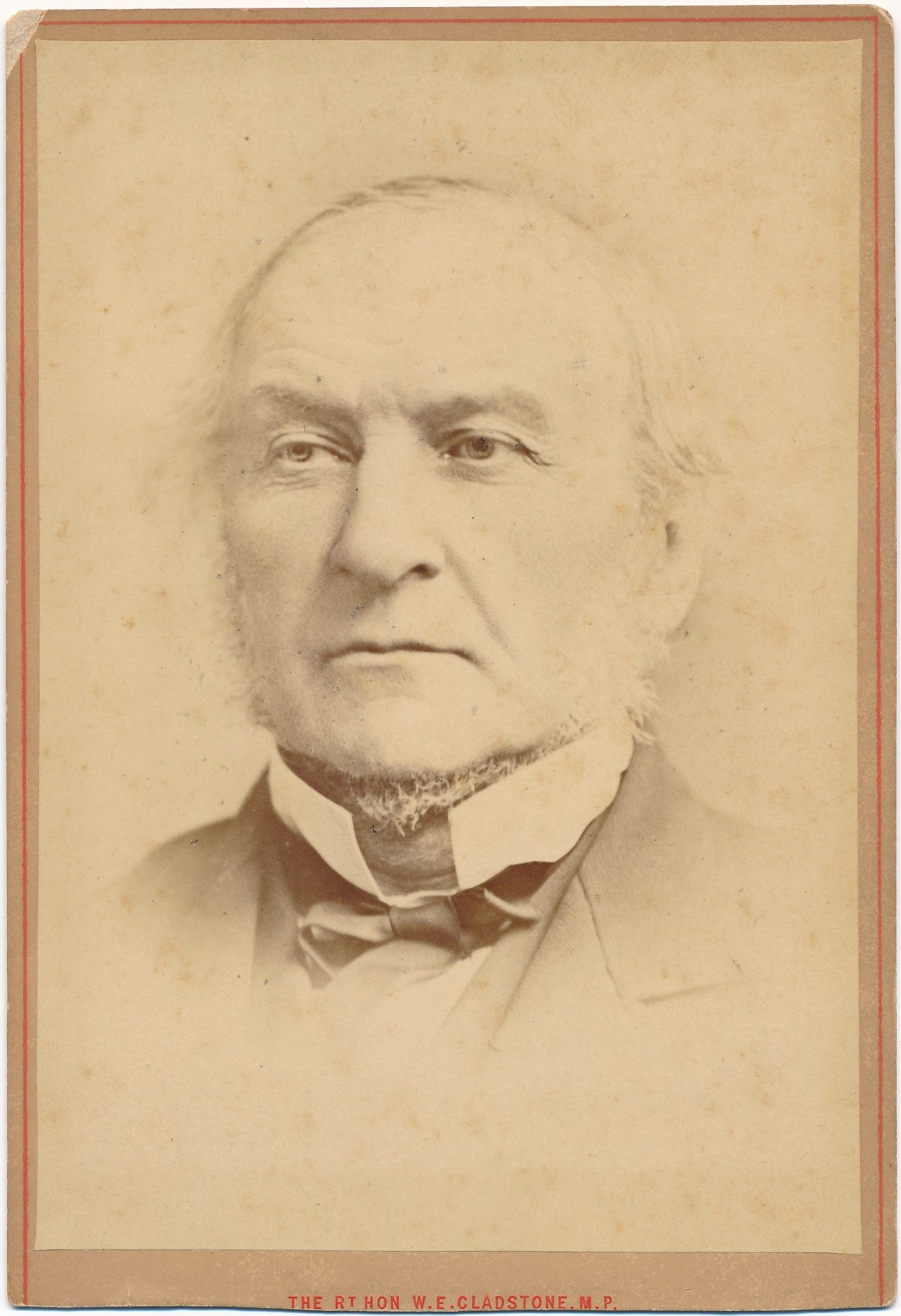
The Rt. Hon. William Ewart Gladstone M.P.
(29 December 1809 – 19 May 1898)
 FRS FSS 
British statesman of the Liberal Party. In a career lasting over sixty years, he served for twelve years as Prime Minister of the United Kingdom, spread over four terms beginning in 1868 and ending in 1894. He also served as Chancellor of the Exchequer four times.
by The London Stereoscopic and Photographic Company


Stratford Canning
(4 November 1786 – 14 August 1880)
1st Viscount Stratford de Redcliffe, KG, GCB, PC 
British diplomat and politician, best known as the longtime British Ambassador to the Ottoman Empire.
by The London Stereoscopic and Photographic Company


Sir John Lubbock P.C., M.P.
 (30 April 1834 – 28 May 1913)
1st Baron Avebury, 4th Baronet, PC, DL, FRS
known as Sir John Lubbock, 4th Baronet from 1865 until 1900, English banker, Liberal politician, philanthropist, scientist and polymath.
by Elliott and Fry


The Rt Hon. John Bright M.P.
(16 November 1811 – 27 March 1889)
British Radical and Liberal statesman, one of the greatest orators of his generation and a promoter of free trade policies.
by The London Stereoscopic and Photographic Company


George John Douglas Campbell
8th Duke of Argyll
(30 April 1823 – 24 April 1900)
 KG, KT, PC, FRS, FRSE, styled Marquess of Lorne until 1847.
 Scottish peer and Liberal politician as well as a writer on science, religion, and the politics of the 19th century.
by London Stereoscopic & Photographic Company
albumen carte-de-visite, circa 1873


Anthony Ashley-Cooper
 (28 April 1801 – 1 October 1885)
7th Earl of Shaftesbury K.G.
  British politician, philanthropist and social reformer. He was the eldest son of Cropley Ashley-Cooper, 6th Earl of Shaftesbury and his wife Lady Anne Spencer, daughter of George Spencer, 4th Duke of Marlborough. 
by The London Stereoscopic and Photographic Company


The Rt. Hon. Joseph Chamberlain, P.C., M.P.
 (8 July 1836 – 2 July 1914)
British statesman who was first a radical Liberal, then, after opposing home rule for Ireland, a Liberal Unionist, and eventually served as a leading imperialist in coalition with the Conservatives.
by Elliott and Fry


The Rt. Hon. William Edward Forster, M.P.
(11 July 1818 – 5 April 1886)
PC, FRS
English industrialist, philanthropist and Liberal Party statesman.
by The London Stereoscopic and Photographic Company


The Rt. Hon. George Joachim Goschen, M.P.
(10 August 1831 – 7 February 1907)
1st Viscount Goschen PC DL, FBA 
British statesman and businessman best remembered for being "forgotten" by Lord Randolph Churchill. He was initially a Liberal, then a Liberal Unionist before joining the Conservative Party by the time of the 1895 General Election.
by Elliott and Fry


The Rt. Hon. John Morley, P.C., M.P.
 (24 December 1838 – 23 September 1923)
1st Viscount Morley of Blackburn, OM, PC, FRS 
British Liberal statesman, writer and newspaper editor.
by Elliott and Fry


Samuel Morley Esq., M.P.
 (15 October 1809 – 5 September 1886)
English woollen manufacturer, philanthropist, dissenter (Congregationalist), abolitionist, political radical and statesman.
 by The London Stereoscopic and Photographic Company


Charles Bradlaugh, M.P.
(26 September 1833 – 30 January 1891) 
English political activist and atheist.
by James Russell and Sons, Baker Street, London


Sir Henry George Elliott GCB
(30 June 1817 – 30 March 1907)
British diplomat.
 by The London Stereoscopic and Photographic Company


Arthur James Balfour
1st Earl of Balfour, KG, OM, PC, FRS, FBA, DL  
(25 July 1848 – 19 March 1930)
British statesman of the Conservative Party who served as Prime Minister of the United Kingdom from 1902 to 1905. As Foreign Secretary from 1916 to 1919, he issued the Balfour Declaration in November 1917.
by James Russell and Sons, 17 Baker Street, Portman Square, London


Sir Wilfrid Lawson
2nd Baronet., M.P.
(4 September 1829 – 1 July 1906) 
Landowner and politician, temperance campaigner and anti-imperialist
by The London Stereoscopic and Photographic Company


Sir Richard Everard Webster
(22 December 1842 – 15 December 1915)
1st Viscount Alverstone, GCMG, PC, FRS
Attorney-General, 4th Lord Chief Justice of England

by James Russell and Sons, 17 Baker Street, Portman Square, London


Sir Charles Fox
(11 March 1810 – 11 June 1874) 
English civil engineer and contractor. His work focused on railways, railway stations and bridges.
by The London Stereoscopic and Photographic Company


John Arthur Roebuck, Esq., Q.C.
(28 December 1802 – 30 November 1879)
British politician
by The London Stereoscopic and Photographic Company
 albumen carte-de-visite, 1873


Samuel Plimsoll, M.P.
(10 February 1824 – 3 June 1898) 
English politician and social reformer, now best remembered for having devised the Plimsoll line.
by The London Stereoscopic and Photographic Company


Sir Charles Arthur Russell, Q.C., M.P.
Baron Russell of Killowen, GCMG, PC, QC, DL 
(10 November 1832 – 10 August 1900) 
Irish statesman and Lord Chief Justice of England.
by Walery, 164 Regent Street, London


Prof. Henry Fawcett, M.P.
(26 August 1833 – 6 November 1884)
British academic, statesman and economist
by The London Stereoscopic and Photographic Company


The Lord Chief Baron
Sir Fitzroy Edward Kelly PC, KC 
(9 October 1796 – 18 September 1880), 
An English commercial lawyer, Tory politician and judge.
by The London Stereoscopic and Photographic Company


The Rt. Hon. Sir James Hannen
later Baron Hannen, PC, FRS 
(19 March 1821 – 29 March 1894)
An English judge.
by Elliott and Fry, 55 Baker Street, London


Late Duke of Wellington
by The London Stereoscopic and Photographic Company


Amiral Nelson
by E Neurdin, 28 Bould de Sebastopol, Paris


Thomas Babington Macaulay
1st Baron Macaulay, FRS FRSE PC
(25 October 1800 – 28 December 1859)
British historian and Whig politician. He wrote extensively as an essayist and reviewer; his books on British history have been hailed as literary masterpieces.
by The London Stereoscopic and Photographic Company


Captain Frederick Marryat
(10 July 1792 – 9 August 1848)
British Royal Navy officer, novelist, and an acquaintance of Charles Dickens.


Henry Peter Brougham
1st Baron Brougham and Vaux, PC QC FRS
(19 September 1778 – 7 May 1868) 

British statesman who became Lord Chancellor of Great Britain
by The London Stereoscopic and Photographic Company


Richard Cobden M.P.
 (3 June 1804 – 2 April 1865)
English manufacturer and Radical and Liberal statesman, associated with two major free trade campaigns, the Anti-Corn Law League and the Cobden–Chevalier Treaty.
published by Marion and Co., 22 & 23 Soho Square, London


Elihu Burritt
(December 8, 1810 – March 6, 1879)
American diplomat, philanthropist and social activist
by Elliott and Fry, 55 Baker Street, Portman Square, London, W.


Roderick Impey Murchison
 (22 February 1792 – 22 October 1871)
1st Baronet KCB DCL FRS FRSE FLS PRGS PBA MRIA 
British geologist who first described and investigated the Silurian system.
by The London Stereoscopic and Photographic Company


Alfred Tennyson
(6 August 1809 – 6 October 1892)
1st Baron Tennyson, FRS
Poet Laureate of Great Britain and Ireland during much of Queen Victoria's reign.


David Livingstone
(19 March 1813 – 1 May 1873)
Scottish Christian Congregationalist, pioneer medical missionary with the London Missionary Society, an explorer in Africa, and one of the most popular British heroes of the late-19th-century Victorian era.
by The London Stereoscopic and Photographic Company


Vice-Admiral Robert FitzRoy RN
(5 July 1805 – 30 April 1865)
English officer of the Royal Navy and a scientist. He achieved lasting fame as the captain of HMS Beagle during Charles Darwin's famous voyage, FitzRoy's second expedition to Tierra del Fuego and the Southern Cone.
As Governor of New Zealand, serving from 1843 to 1845, he tried to protect the Māori from illegal land sales claimed by British settlers.
 Through his father, General Lord Charles FitzRoy, Robert was a fourth great-grandson of Charles II of England.
by The London Stereoscopic and Photographic Company


Sir Henry Thompson
 (6 August 1820 – 18 April 1904)
1st Baronet, FRCS 
British surgeon and polymath.
by The London Stereoscopic and Photographic Company

 
Admiral The Honourable Henry John Rous 
(23 January 1795 – 19 June 1877) 
Officer of the British Royal Navy, who served during the Napoleonic Wars, and was later a Member of Parliament and a leading figure in horse racing.
a copy of this photograph is in the Royal Collection, item RCIN 2907089
by Russell and Sons, Chichester and Worthing


Archibald Forbes 
(17 April 1838 – 30 March 1900)
Scottish war correspondent.
by Disderi, Brook Street, Hanover Square, London


Thomas Henry Huxley 
PC PRS FLS
(4 May 1825 – 29 June 1895)
English biologist specialising in comparative anatomy. He is known for his advocacy of Charles Darwin's theory of evolution.
by Elliott & Fry
albumen cabinet card, 1885


Ferdinand Marie de Lesseps
(19 November 1805 – 7 December 1894)

Vicomte de Lesseps GCSI 
French diplomat and later developer of the Suez Canal, which in 1869 joined the Mediterranean and Red Seas.
He was a cousin of the Countess of Montijo, the mother of Empress Eugenie.
 by The London Stereoscopic and Photographic Company


Heinrich Schliemann 
(6 January 1822 – 26 December 1890)
German businessman and a pioneer in the field of archaeology. He was an advocate of the historicity of places mentioned in the works of Homer and an archaeological excavator of Hissarlik, now presumed to be the site of Troy, along with the Mycenaean sites Mycenae and Tiryns.

by The London Stereoscopic and Photographic Company


Wilkie Collins  
William Wilkie Collins
(8 January 1824 – 23 September 1889)
English novelist, playwright, and short story writer. His best-known works are The Woman in White (1859), No Name (1862), Armadale (1866) and The Moonstone (1868). The last is considered the first modern English detective novel.
by Elliott and Fry


James Anthony Froude 
FRSE
(23 April 1818 – 20 October 1894)

English historian, novelist, biographer, and editor of Fraser's Magazine.
by The London Stereoscopic and Photographic Company


Henry Du Pré Labouchère
(9 November 1831 – 15 January 1912)
English politician, writer, publisher and theatre owner in the Victorian and Edwardian eras.
by Elliott and Fry


William Cowper 
(26 November 1731 – 25 April 1800)
English poet and hymnodist. 
by The London Stereoscopic and Photographic Company


Lord Byron, Sir Walter Scott, Felicia Dorothea Hemans, Thomas Moore, Robert Southey, Percy B. Shelly.
Published by W. Hughes and Edmunds, 120 Cheapside, London, E.C.


William Shakespeare 
(1564 – 1616)


Sir Walter Scott
1st Baronet, FRSE 
(15 August 1771 – 21 September 1832)
was a Scottish historical novelist, playwright, poet and historian. 
by The London Stereoscopic and Photographic Company


George Gordon Byron
6th Baron Byron FRS
(22 January 1788 – 19 April 1824)
known as Lord Byron, English nobleman, poet, peer, politician, and leading figure in the Romantic movement. He is regarded as one of the greatest British poets and remains widely read and influential. Among his best-known works are the lengthy narrative poems Don Juan and Childe Harold's Pilgrimage as well as the short lyric poem "She Walks in Beauty".
by The London Stereoscopic and Photographic Company


John Milton
(9 December 1608 – 8 November 1674)
English poet, polemicist, man of letters, and civil servant for the Commonwealth of England under Oliver Cromwell. He wrote at a time of religious flux and political upheaval, and is best known for his epic poem Paradise Lost (1667), written in blank verse.


Thomas Carlyle
(4 December 1795 – 5 February 1881)
Scottish philosopher, satirical writer, essayist, translator, historian, mathematician, and teacher. Considered one of the most important social commentators of his time, he presented many lectures during his lifetime with certain acclaim in the Victorian era.
by Elliott and Fry

Thomas Carlyle's signature Wikimedia Commons


Sir David Brewster
KH PRSE FRS FSA(Scot) FSSA MICE
(11 December 1781 – 10 February 1868)
British scientist, inventor, author, and academic administrator. In science he is principally remembered for his experimental work in physical optics, mostly concerned with the study of the polarization of light and including the discovery of Brewster's angle.
by The London Stereoscopic and Photographic Company


Charles Robert Darwin
FRS FRGS FLS FZS
(12 February 1809 – 19 April 1882)
English naturalist, geologist and biologist, best known for his contributions to the science of evolution. He established that all species of life have descended over time from common ancestors.
by Elliott and Fry


Charles Darwin's signature
Wikipedia


Samuel Johnson
(1709  – 1784)
often referred to as Dr. Johnson, was an English writer who made lasting contributions to English literature as a poet, essayist, moralist, literary critic, biographer, editor and lexicographer.


Thomas Henry Huxley 
PC PRS FLS
(4 May 1825 – 29 June 1895)
English biologist specialising in comparative anatomy. He is known for his advocacy of Charles Darwin's theory of evolution.by The London Stereoscopic and Photographic Company


John Tyndall FRS
(2 August 1820 – 4 December 1893)
prominent 19th-century Irish physicist. His initial scientific fame arose in the 1850s from his study of diamagnetism. Later he made discoveries in the realms of infrared radiation and the physical properties of air.
by Elliott and Fry


Sir Joseph Dalton Hooker 
OM GCSI CB PRS 
(30 June 1817 – 10 December 1911)
British botanist and explorer in the 19th century. He was a founder of geographical botany and Charles Darwin's closest friend. For twenty years he served as director of the Royal Botanical Gardens, Kew, succeeding his father, William Jackson Hooker, and was awarded the highest honours of British science.

by The London Stereoscopic and Photographic Company


Michael Faraday FRS
(22 September 1791 – 25 August 1867)
English scientist who contributed to the study of electromagnetism and electrochemistry. His main discoveries include the principles underlying electromagnetic induction, diamagnetism and electrolysis.

by The London Stereoscopic and Photographic Company


Oliver Goldsmith
(10 November 1728 – 4 April 1774)
Irish novelist, playwright and poet


Sir Joseph Whitworth
1st Baronet
(21 December 1803 – 22 January 1887)
English engineer, entrepreneur, inventor and philanthropist. In 1841, he devised the British Standard Whitworth system, which created an accepted standard for screw threads. Whitworth also created the Whitworth rifle, often called the "sharpshooter" because of its accuracy and considered one of the earliest examples of a sniper rifle.
by The London Stereoscopic and Photographic Company


Henry Wadsworth Longfellow
(February 27, 1807 – March 24, 1882) 
American poet and educator whose works include "Paul Revere's Ride", The Song of Hiawatha, and Evangeline. He was also the first American to translate Dante Alighieri's Divine Comedy and was one of the five Fireside Poets from New England.


Alfred Tennyson
(6 August 1809 – 6 October 1892)
1st Baron Tennyson, FRS
Poet Laureate of Great Britain and Ireland during much of Queen Victoria's reign.
by The London Stereoscopic and Photographic Company


Charles John Huffam Dickens
(7 February 1812 – 9 June 1870)
English writer and social critic. He created some of the world's best-known fictional characters and is regarded by many as the greatest novelist of the Victorian era.[1] His works enjoyed unprecedented popularity during his lifetime, and by the 20th century critics and scholars had recognised him as a literary genius. His novels and short stories enjoy lasting popularity.

by The London Stereoscopic and Photographic Company


Paul Gustave Louis Christophe Doré
(6 January 1832 – 23 January 1883)
French artist, printmaker, illustrator, comics artist, caricaturist and sculptor who worked primarily with wood engraving.
by The London Stereoscopic and Photographic Company


George Frideric Handel 
(born Georg Friedrich Händel
(1685 - 1759) German, later British, Baroque composer who spent the bulk of his career in London, becoming well-known for his operas, oratorios, anthems, and organ concertos. 


Sir John Everett Millais
1st Baronet, PRA
(8 June 1829 – 13 August 1896)
English painter and illustrator who was one of the founders of the Pre-Raphaelite Brotherhood.

by The London Stereoscopic and Photographic Company


Sir John Tenniel
(28 February 1820 – 25 February 1914)
English illustrator, graphic humorist, and political cartoonist prominent in the second half of the 19th century. He was knighted for his artistic achievements in 1893. Tenniel is remembered especially as the principal political cartoonist for Punch magazine for over 50 years, and for his illustrations to Lewis Carroll's Alice's Adventures in Wonderland (1865) and Through the Looking-Glass, and What Alice Found There (1871).
by Elliott and Fry


Sir John Gilbert RA
(21 July 1817 – 5 October 1897)
English artist, illustrator and engraver.
by The London Stereoscopic and Photographic Company


Robert Browning
(7 May 1812 – 12 December 1889)
English poet and playwright whose mastery of the dramatic monologue made him one of the foremost Victorian poets. His poems are known for their irony, characterization, dark humour, social commentary, historical settings, and challenging vocabulary and syntax.

by Elliott and Fry


George Dalziel
(1 December 1815 – August 1902)
Draughtsman and wood-engraver, George Dalziel was the Brothers Dalziel firm's most senior member. After moving to London aged nineteen and studying under the wood-engraver Charles Gray for four years, he established what was to become the family engraving firm. His early work included commissions from Ebenezer Landells for Punch and the Illustrated London News.
by Elliott and Fry


Joseph Addison
(1 May 1672 – 17 June 1719)
English essayist, poet, playwright, and politician.


Emily Faithfull
(1835–1895)
English women's rights activist, and publisher.

by Elliott and Fry


Amelia Ann Blanford Edwards
(7 June 1831 – 15 April 1892)
English novelist, journalist, traveller and Egyptologist. Her most successful literary works included the ghost story "The Phantom Coach" (1864), the novels Barbara's History (1864) and Lord Brackenbury (1880), and the Egyptian travelogue A Thousand Miles up the Nile (1877), which described her 1873–1874 voyage.
by Elliott and Fry


Mrs Fry
Elizabeth Fry (née Gurney; 21 May 1780 – 12 October 1845), was an English prison reformer, social reformer, philanthropist and Quaker,
by Elliott and Fry


Mrs Garrett Anderson
Elizabeth Garrett Anderson (9 June 1836 – 17 December 1917) was an English physician and suffragist. She was the first woman to qualify in Britain as a physician and surgeon. She was the co-founder of the first hospital staffed by women, the first dean of a British medical school, the first woman in Britain to be elected to a school board and, as mayor of Aldeburgh, the first female mayor in Britain.
by Elliott and Fry


Charles Stewart Parnell
(27 June 1846 – 6 October 1891)
Irish nationalist politician and one of the most powerful figures in the British House of Commons in the 1880s.

by William Lawrence, 5 and 7 O'Connell Street, Dublin


Angela Georgina Burdett-Coutts
1st Baroness Burdett-Coutts
(21 April 1814 – 30 December 1906)
born Angela Georgina Burdett, was a nineteenth-century philanthropist, the daughter of Sir Francis Burdett, 5th Baronet and Sophia, formerly Coutts, daughter of banker Thomas Coutts. In 1837 she became one of the wealthiest women in England when she inherited her grandfather's fortune of around £1.8 million pounds sterling (equivalent to £150,000,000 in 2016) following the death of her stepgrandmother, Harriot Mellon. She joined the surnames of her father and grandfather, by royal licence, to become Burdett-Coutts. Edward VII is reported to have described her as, "[a]fter my mother, the most remarkable woman in the kingdom".
by The London Stereoscopic and Photographic Company 


Mrs Becker
  Lydia Ernestine Becker (24 February 1827 – 18 July 1890) was a leader in the early British suffrage movement, as well as an amateur scientist with interests in biology and astronomy. She established Manchester as a centre for the suffrage movement and with Richard Pankhurst she arranged for the first woman to vote in a British election and a court case was unsuccessfully brought to exploit the precedent. Becker is also remembered for founding and publishing the Women's Suffrage Journal between 1870 and 1890.
by Elliott and Fry

 
Michael Davitt
(25 March 1846 – 30 May 1906)
Irish republican and agrarian campaigner who founded the Irish National Land League. He was also a labour leader, Home Rule politician and Member of Parliament (MP). He campaigned for Home Rule and was a close ally of Charles Stuart Parnell, the leader of the Irish Parliamentary Party, until the party split over Parnell's divorce and Davitt joined the anti-Parnellite Irish National Federation.
by William Lawrence, 5 and 7 O'Connell Street, Dublin


Pope Pius IX 
(13 May 1792 – 7 February 1878)
born Giovanni Maria Mastai-Ferretti, was head of the Catholic Church from 16 June 1846 to his death on 7 February 1878. He was the longest-reigning elected pope in the history of the Catholic Church, serving for over 31 years.
by The London Stereoscopic and Photographic Company


Nathan Marcus HaKohen Adler
(13 January 1803 – 21 January 1890)
 (Hebrew name: Natan ben Mordechai ha-Kohen)
Orthodox Chief Rabbi of the British Empire from 1845 until his death.
by The London Stereoscopic and Photographic Company


Monsignor Thomas John Capel
(born 28 October 1836, Ireland – died 23 October 1911, Sacramento, California)
Roman Catholic priest.
by The London Stereoscopic and Photographic Company


not identified
by Mason and Co., London and Norwich


William Henry Smith, FRS
(24 June 1825 – 6 October 1891)
English bookseller and newsagent of the family firm W H Smith, who expanded the firm and introduced the practice of selling books and newspapers at railway stations. He was elected a Member of Parliament in 1868 and rose to the position of First Lord of the Admiralty less than ten years thereafter. In the mid-1880s, he was twice Secretary of State for War, and later First Lord of the Treasury and Leader of the House of Commons, among other posts.

by Elliott and Fry


William Thomson
FRS, FRGS 
(11 February 1819 – 25 December 1890)
Archbishop of York from 1862 until his death.
by The London Stereoscopic and Photographic Company


Archibald Campbell Tait
(21 December 1811 – 3 December 1882)
Archbishop of Canterbury

by The London Stereoscopic and Photographic Company

 
Arthur Penrhyn Stanley, FRS
(13 December 1815 – 18 July 1881)
English churchman and academic. He was Dean of Westminster from 1864 to 1881.
by The London Stereoscopic and Photographic Company


Richard Chenevix Trench
(9 September 1807 – 28 March 1886)
Anglican archbishop and poet. Trench joined the Canterbury Association on 27 March 1848. In 1856 Trench became Dean of Westminster Abbey and in January 1864 he was advanced to the post of Archbishop of Dublin.
by The London Stereoscopic and Photographic Company


Sir William George Granville Venables Vernon Harcourt, KC
(14 October 1827 – 1 October 1904)
British lawyer, journalist and Liberal statesman. He served as Member of Parliament for various constituencies and held the offices of Home Secretary and Chancellor of the Exchequer under William Ewart Gladstone before becoming Leader of the Opposition.
by Alexander Bassano, 25 Old Bond Street, London


Charles John Vaughan
(16 August 1816 – 15 October 1897)
English scholar and Anglican churchman.
by The London Stereoscopic and Photographic Company


John Jackson
(22 February 1811 – 5 January 1885)
British divine and a Church of England bishop for 32 years.
Jackson was appointed Bishop of Lincoln in 1853 then in 1868, Jackson was unexpectedly selected by Disraeli, then prime minister, to be Bishop of London where he continued until his retirement in 1885.

by The London Stereoscopic and Photographic Company


John William Colenso
(24 January 1814 – 20 June 1883)
British mathematician, theologian, Biblical scholar and social activist, who was the first Church of England Bishop of Natal.
His cousin was William Colenso, a missionary in New Zealand.
by The London Stereoscopic and Photographic Company


James Fraser
(18 August 1818 – 22 October 1885)
Anglican bishop of Manchester.
by The London Stereoscopic and Photographic Company


Henry James
1st Baron James of Hereford, GCVO, PC, KC 
(30 October 1828 – 18 August 1911)
Anglo-Welsh lawyer and statesman. Initially a Liberal, he served under William Ewart Gladstone as Solicitor General in 1873 and as Attorney-General between 1873 and 1874 and 1880 and 1885.
by Russell and Sons, London


John Cumming FRSE
(10 November 1807 – 5 July 1881)
Scottish clergyman.
by The London Stereoscopic and Photographic Company


James Oswald Dykes
(14 August 1835 - 1 January 1912)
Scottish Presbyterian clergyman and educator.
by Elliott and Fry


Donald Fraser, M.A., D.D.
 (15 January 1826 - 12 February 1892)
Pastor of the Marylebone Presbyterian Church, and Moderator of the Synod of the Presbyterian Church of England
by Elliott and Fry


Charles Haddon Spurgeon 
(19 June 1834 – 31 January 1892)
English Particular Baptist preacher.
by J. F. Knights


Rev. Dr. Christopher Newman Hall LLB
(22 May 1816 – 18 February 1902)
known in later life as a 'Dissenter's Bishop', he was one of the most celebrated nineteenth century English Nonconformist divines. He was active in social causes; supporting Abraham Lincoln and abolition of slavery during the American Civil War, the Chartist cause, and arranging for influential Nonconformists to meet Gladstone.
by The London Stereoscopic and Photographic Company


Hugh Reginald Haweis
(3 April 1838 – 29 January 1901)
English cleric and writer. He was the husband of author Mary Eliza Haweis and the father of painter Stephen Haweis.
by Elliott and Fry


  Georgiana Cavendish, Duchess of Devonshire.
Copy of the Stolen "Duchess of Devonshire" by Thomas Gainsborough
 The painting was stolen from the London gallery of Thomas Agnew & Sons in 1876 and recovered in America in 1901. It was later put up for sale at Sotheby's in 1994 and purchased by the 11th Duke of Devonshire for the Chatsworth House collection
 by The London Stereoscopic and Photographic Company
 
 
Other Photographs not part of this album


Philip Reginald Egerton 
(14 July 1832 – 28 April 1911) 
was an English Church of England priest and schoolmaster, who re-founded Bloxham School in Oxfordshire in 1860.
photographed by Hills and Saunders, Oxford and Cambridge
[purchased New Zealand July 2023]


Edward VII 
(9 November 1841 – 6 May 1910)
King of the United Kingdom and the British Dominions and Emperor of India from 22 January 1901 until his death in 1910.
The eldest son of Queen Victoria and Prince Albert of Saxe-Coburg and Gotha.


Princess Alexandra
 Alexandra of Denmark 
(1 December 1844 – 20 November 1925) 
Wife of King Edward VII, Queen of the United Kingdom and the British Dominions and Empress of India.


Princess Alexandra and Princess Louise
photographed by W. & D. Downey, September 1868
[purchased New Zealand August 2024]


Edward VII 
(9 November 1841 – 6 May 1910)
King of the United Kingdom and the British Dominions and Emperor of India from 22 January 1901 until his death in 1910.
The eldest son of Queen Victoria and Prince Albert of Saxe-Coburg and Gotha.

by Alexander Bassano, 25 Old Bond Street, London


H.I.H. The Grand Duchess Marie
Grand Duchess Maria Alexandrovna of Russia
(17 October 1853 – 22 October 1920)
by The London Stereoscopic and Photographic Company

 
The Rt. Hon. William Ewart Gladstone M.P.
(29 December 1809 – 19 May 1898)
 FRS FSS 
British statesman of the Liberal Party. In a career lasting over sixty years, he served for twelve years as Prime Minister of the United Kingdom, spread over four terms beginning in 1868 and ending in 1894. He also served as Chancellor of the Exchequer four times.
by The London Stereoscopic and Photographic Company
 
 
"Impératrice Eugénie"
by Ellisson & Co., 39 St John Street, Quebec
[This is unlike other portraits of Empress Eugenie and may not be her]
 
 
Empress Eugénie
by
Sergei Luvovich Levitsky 22 Rue de Choieul, Paris
ca. 1864


The Prince Imperial
Killed by the Zulus [1 June 1879 aged 23 years near Ulundi, Zulu Kingdom]
purchased May 2023


Queen Victoria and Princess Louise
by André Adolfe Eugène Disdéri [1819-89]
 November 1866

 
Queen Victoria
by Charles Clifford
albumen carte-de-visite, 14 November 1861
Queen Victoria wrote about the sitting for Clifford in her journal dated 14 November 1861 
that she was "dressed in evening dress, with diadem & jewels" and was "photographed for the Queen of Spain by Mr Clifford. He brought me one of hers, taken by him".
 
 
Adelina Patti as Marguerite in Charles Gounod's Faust. 
 born 19 February 1843 – died 27 September 1919
 Italian 19th-century opera singer, earning huge fees at the height of her career in the music capitals of Europe and America. She first sang in public as a child in 1851, and gave her last performance before an audience in 1914. Along with her near contemporaries Jenny Lind and Thérèse Tietjens, Patti remains one of the most famous sopranos in history, owing to the purity and beauty of her lyrical voice and the unmatched quality of her bel canto technique.
by Charles Reutlinger, 21 Boulevard Montmartre, Paris.


Dame Alice Ellen Terry GBE
 (27 February 1847 – 21 July 1928)
Leading English actress of the late 19th and early 20th centuries.
Miss Ellen Terry as "Beatrice" in "Much Ado About Nothing"
by Window and Grove, London.